
BY PHESHEYA KUNENE
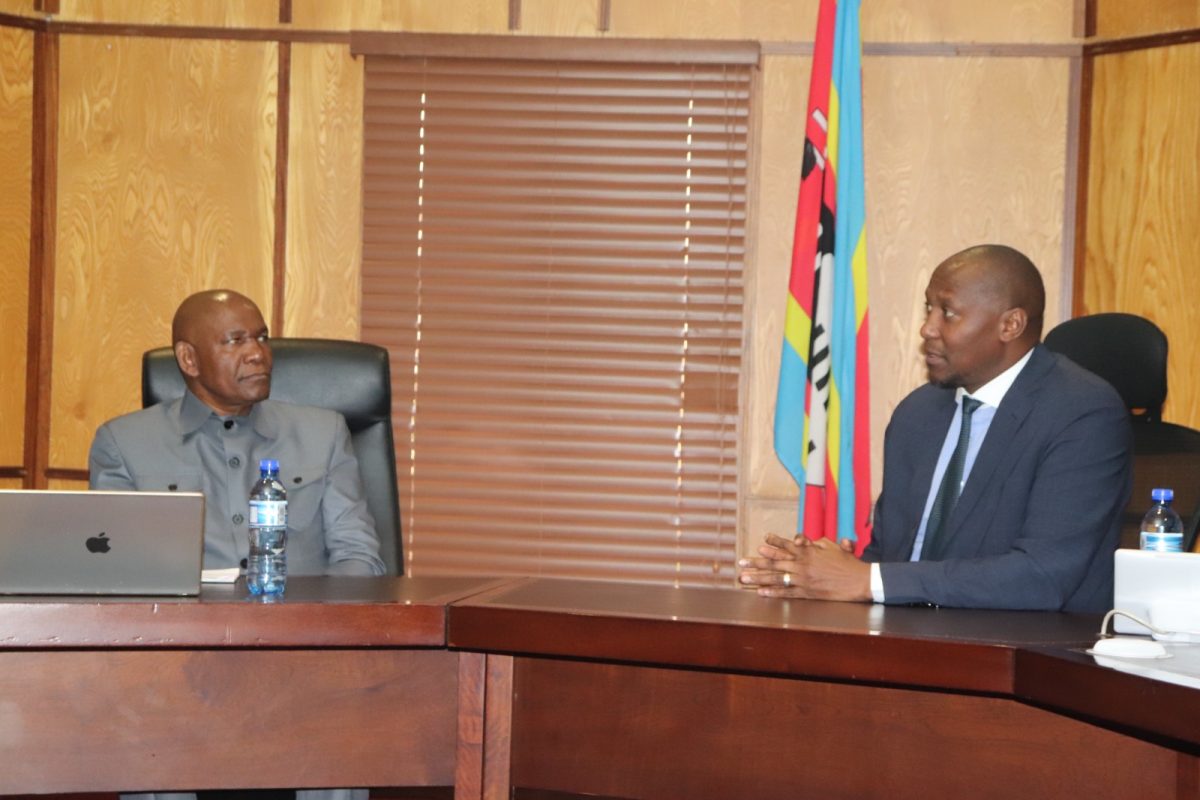
MBABANE – Prime Minister Russell Mmiso Dlamini has officially appointed and commissioned the SADC University of Transformation Board, tasking it with urgently establishing the institution and positioning Eswatini as a regional hub for science, innovation, and skills development.
At the centre of this high-stakes assignment is Board Chairperson Dr Simanga Alex Tsela, deputised by Professor Innocent Msibi, alongside a technically diverse team comprising Dr Rejoice Maseko, Zandile Dlamini, Mboni Dlamini, Victor Langa, and Welile Kunene. Their mandate is neither ceremonial nor incremental. It is structural, systemic, and time-bound.
They are to build, almost from first principles, a university that does not merely educate, but transforms.
Government sources describe the institution as a flagship intervention aligned with regional priorities under the Southern African Development Community (SADC), positioning Eswatini as an intellectual anchor within a bloc increasingly aware that economic sovereignty is now inseparable from knowledge production.
In his remarks, the Prime Minister dispensed with pleasantries and moved straight to performance metrics.
“Ensure this becomes the best university in Southern Africa, one that is recognised and endorsed by leading institutions globally,” he said.
“Begin developing the curriculum immediately so that ESHEC can initiate the accreditation process. You must prioritise STEM disciplines and ensure strong linkages between academia and industry.”
It was less a speech than a directive.
A UNIVERSITY, OR AN ECONOMIC INSTRUMENT?
Beneath the ceremonial language lies a harder truth: Eswatini is attempting to engineer a structural pivot.
For years, economists have warned that the country’s growth ceiling is constrained not only by external shocks, but by a narrow skills base and weak innovation pipelines. Data from the World Bank shows that tertiary enrolment across Sub-Saharan Africa remains below 10 percent, while the UNESCO consistently flags the region’s marginal contribution to global research output, at under 1 percent.
The implications are stark. Countries that do not produce knowledge, import it. And those that import knowledge, often import dependency.
The SADC University of Transformation is designed, at least in theory, to disrupt that cycle.
Its emphasis on STEM is not incidental. It is a calculated response to a labour market increasingly defined by precision agriculture, climate-smart technologies, data analytics, and industrial automation. For a country where agriculture remains a backbone of the economy, the intersection between science and production is no longer optional, it is existential.
An agriculture economist based in Mbabane, speaking on condition of anonymity, said the university could become “a game-changer for value chain development, particularly if it embeds research directly into farming systems, agro-processing, and export logistics.”
“If done correctly, this is not just about degrees,” the economist said. “It is about productivity.”
FROM VISION TO VELOCITY
Yet, history offers caution.
Across the continent, flagship universities have often faltered at the altar of underfunding, bureaucratic inertia, and curriculum irrelevance. The gap between political vision and institutional execution remains one of Africa’s most persistent development fault lines.
It is precisely this gap that the Prime Minister appeared keen to close.
He urged the board to demonstrate agility, a word rarely used in government corridors, and to uphold discipline and respect for authority, signalling that the project carries not only developmental weight, but national significance tied to His Majesty’s vision.
In response, Dr Tsela projected confidence without drifting into rhetoric.
“We recognise this as a national asset and will galvanise patriotism to ensure its success,” he said, adding that a detailed strategic plan is already under development and will be presented in the coming weeks.
Insiders suggest the plan will prioritise phased infrastructure rollout, international partnerships, and aggressive resource mobilisation, including potential private sector participation.
THE STAKES
If successful, the university could recalibrate Eswatini’s economic architecture, shifting it from a consumption-driven model toward a production-oriented, knowledge-based economy.
It could also reposition the country within SADC, not merely as a participant, but as a convenor of ideas, research, and innovation.
But the margin for error is thin.
Accreditation timelines, faculty recruitment, funding pipelines, and curriculum design will determine whether the institution emerges as a regional powerhouse or another underperforming asset weighed down by ambition.
For now, the board has its orders. The clock is running.
And in a region where the future increasingly belongs to those who can think, design, and build, the SADC University of Transformation is more than an academic project.
It is a test of whether Eswatini can convert vision into velocity, and policy into productivity.