
BY PHESHEYA KUNENE
EZULWINI – The Central Bank of Eswatini’s recent decision to maintain the discount rate at 6.75 per cent has drawn a spectrum of reactions from regulators, economists, and agricultural leaders, all of whom agree that while the move ensures macroeconomic stability, it leaves the nation's farmers facing a difficult financial path.
The Regulator’s Stance: Stability Amidst Global Turbulence
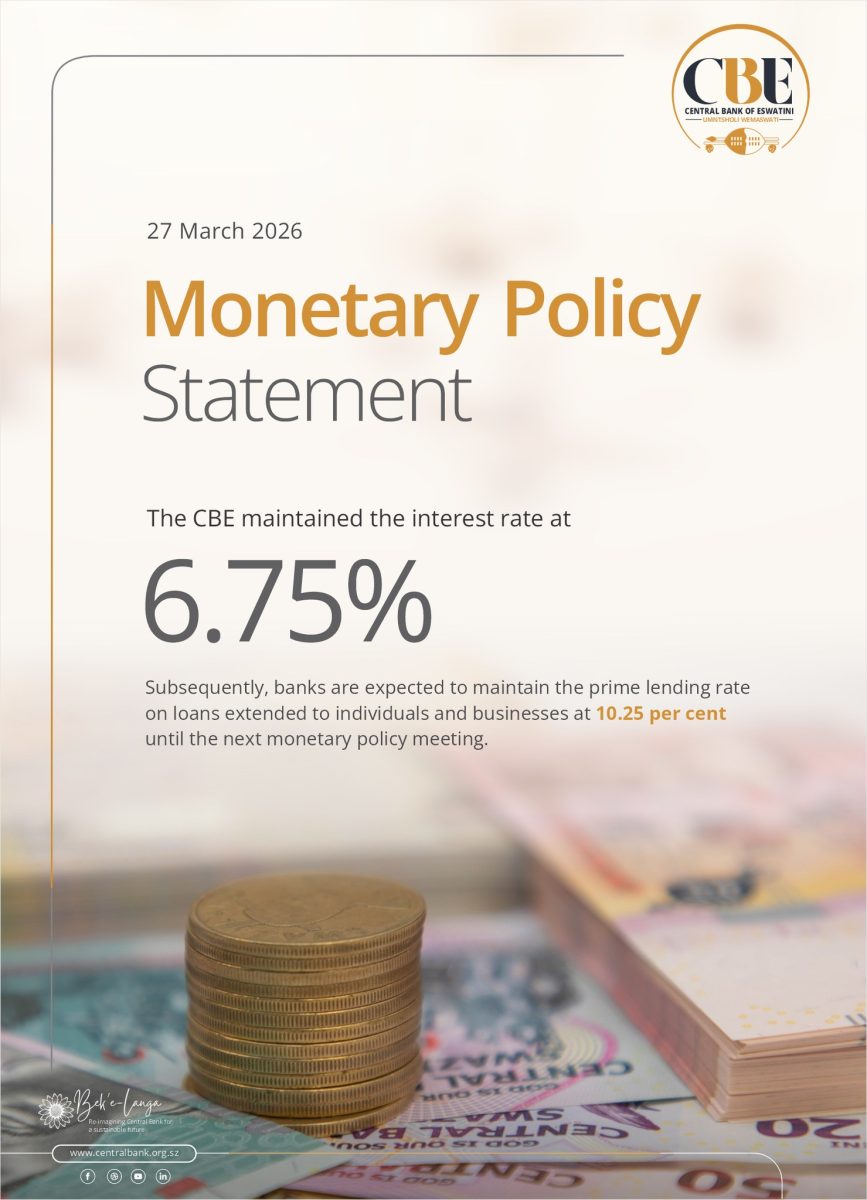
Presenting the Monetary Policy Statement on March 27, 2026, Governor Phil Mnisi emphasized a “cautious approach” necessitated by persistent global uncertainty. While headline inflation has slowed to 1.9 per cent (down from 2.1 per cent in January), the Bank remains wary of "upside inflation risks" linked to geopolitical tensions and volatile commodity markets.
Governor Mnisi noted that keeping the rate aligned with South Africa is vital to prevent currency instability and capital outflows, especially as the lilangeni remains pegged to the rand. For the Bank, the priority remains price stability in a volatile global environment.
Economists' Critique: Beyond Inflation to Capital Access
While the Bank prioritizes stability, local economists argue that the real threat to growth has shifted. Welcome Nxumalo observed that the rate hold, while anchoring the macroeconomy, does little to resolve the “structural financing challenges” facing the agricultural sector. Nxumalo pointed out that the primary hurdle for farmers is no longer inflation, but rather access to affordable capital. He warned that without targeted credit interventions, smallholders will continue to be excluded from growth opportunities.

Sharing this concern, economist Sanele Sibiya characterized the Bank’s stance as “unmistakably cautious”. He warned that holding rates at current levels—with the prime lending rate near 10.25 per cent—risks muting growth in credit-dependent sectors like agriculture. Sibiya further noted that monetary policy is a "demand-side tool" ill-equipped to fix supply-side disruptions, such as rising costs for electricity (up 6.9%) and water (up 4.0%), which continue to squeeze farm margins.
The Farming Community: Stability is Not Relief
From the perspective of those on the ground, the response was even more direct. ESNAU CEO Tammy Dlamini stated that while the decision provides stability, it offers “not relief” to the farming community.
Dlamini highlighted a growing divide in the sector:
- Barriers to Entry: High borrowing costs remain a wall preventing smallholders from investing in irrigation, mechanization, and modern farming methods.
- Widening Inequality: Larger commercial operations are better equipped to navigate high interest rates, while emerging farmers risk being "locked out" of the market.
- The Borrower’s Dilemma: Dlamini reminded stakeholders that farmers are not just price-takers but also borrowers; if credit remains expensive, agricultural growth will remain slow, directly threatening food security.
Conclusion: A Call for a Broad Policy Mix
The consensus among these diverse voices is clear: monetary policy alone cannot transform agriculture. While the Central Bank has created a stable environment, unlocking the sector's potential will require a more comprehensive approach.
Both Sibiya and Nxumalo called for a “complementary policy mix” that includes targeted credit facilities, subsidized lending, and risk-sharing mechanisms tailored specifically for agribusiness. As the 2026 season progresses, the challenge for Eswatini is to move beyond mere prudence and implement the structural supports needed to turn stability into tangible growth for the nation's farmers.