

BY: PHESHEYA KUNENE | EDITOR
MANZINI — Eswatini’s piggery sector has achieved something rare in African agriculture: sustained self-sufficiency. But as a recent industry engagement session made clear, sufficiency is no longer the finish line — competitiveness is.
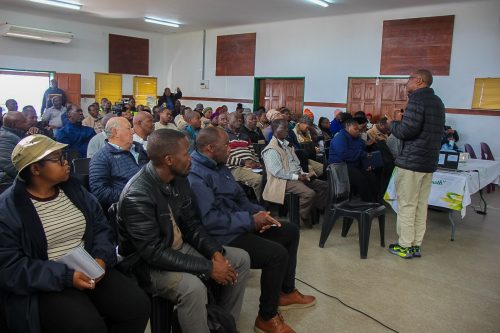
That message came into sharp focus at the Youth Enterprise Revolving Fund (YERF) Piggery Engagement Session, where policymakers, financiers and young farmers gathered to confront a persistent paradox: why does a sector capable of meeting national demand still struggle to scale?
At the centre of the discussion was Duncan Dlamini of DJD Piggery — current Entrepreneur of the Year — whose presentation delivered both a technical roadmap and a commercial reality check. His intervention came at a pivotal moment, as YERF publicly confirmed a shift towards value-chain financing, mandatory training and tighter risk controls for youth-funded agricultural enterprises.
A Sector That Produces Enough, But Struggles to Scale
Official agricultural data shows that Eswatini has maintained pork self-sufficiency since 2019, effectively eliminating the need for sustained imports as domestic production has kept pace with national demand. Imports of fresh pork have fallen to near-zero levels since 2020 — a reflection of the sector’s improved supply capacity.
Output figures tell a story of uneven growth. Pork production climbed to approximately 2,045 tonnes in 2020, before peaking at around 2,370 tonnes in 2021 — a short-term expansion that gave way to volatility driven by rising input costs, disease pressures and market fragmentation. Broader meat production across Eswatini stood at around 22,032 tonnes in 2023, representing a 15 percent decline from the prior year and underscoring system-wide pressures across the livestock economy.

While exports remain modest and variable — with pork export earnings exceeding E1 million in recent periods but heavily dependent on production cycles and compliance with regional standards — the sector’s dual reality is clear: minimal imports, but limited export capacity. Eswatini produces enough. It does not yet trade enough.
DJD’s Mozambique Bet: Scale as Strategy
It is against this backdrop that DJD Piggery’s planned expansion into Mozambique has drawn industry attention. Dlamini confirmed that the business is preparing to supply Matola — a fast-growing urban and industrial corridor with an estimated population of six million — where a commercial client has already been secured.
For DJD, the move is not merely geographic diversification. It is a structural stress test: can Eswatini-based producers transition from domestic sufficiency into regional supply chains that demand consistency, volume and strict compliance with buyer specifications? In Dlamini’s framing, Mozambique is less an opportunity than a discipline test — and that framing says a great deal about the seriousness with which he approaches commercial scale.
The Youth Question: Markets, Costs and Entry Barriers
Young farmers at the session raised recurring concerns that reflect a broader frustration across the sector: inconsistent market access, pricing volatility and the cost of compliance with commercial standards. Many questioned whether piggery farming genuinely offers scalable returns — or whether the industry remains locked in a cycle of smallholder fragmentation.
Practical barriers featured prominently. Participants cited limited access to finance for adequately sized production units, unreliable buyer contracts and weak aggregation systems that leave individual farmers exposed to market swings. While enthusiasm for agriculture as an employment and enterprise pathway remained high, one conclusion was unavoidable: scale determines survival.
YERF’s Policy Shift: Funding With Conditions
YERF CEO Mandla Nkambule responded with a clear and deliberate change in direction. The fund is moving away from standalone project financing towards a structured agricultural value-chain model — one that links capital disbursement to technical readiness, production systems and demonstrated market discipline.
Under the new framework, youth piggery farmers will be required to complete mandatory training under DJD Piggery before qualifying for funding. Nkambule was direct: the objective is not to distribute capital, but to reduce failure rates by enforcing commercial discipline at the point of entry.
YERF is also working with financial institutions and micro-funders to reduce the risk profile of agricultural lending. Mandatory insurance coverage, baseline studies and continuous farm monitoring are being introduced as part of a broader shift toward risk-managed financing.
The developmental ambition is explicit: to produce commercially viable entrepreneurs capable of building scalable agribusinesses — not subsistence operations — and positioning them to compete in regional markets.
DJD’s Model: Structure Over Sentiment
Dlamini’s presentation aligned closely with YERF’s new direction. His core argument: the piggery sector’s chief constraint is not demand — it is structure. Too many farmers operate without reliable records, production planning or financial discipline, making it impossible to consistently meet processor standards or sustain growth.
Commercially viable operations, he argued, are built on measurable systems — feed efficiency tracking, breeding schedules, mortality records and cash flow management. Without these, farmers lack visibility, and without visibility, they lack control.
A recurring theme was financial discipline. Dlamini cautioned against treating livestock revenue as personal cash flow, instead urging structured reinvestment and formal financial record-keeping as the foundation for building creditworthy businesses. Lenders, he noted, increasingly read financial behaviour as a proxy for business viability.
Genetics, Infrastructure and the Productivity Gap
Technical constraints also featured prominently. Dlamini noted that carcass weights in South Africa average approximately 85kg, while many Eswatini producers remain closer to 75kg — a gap driven largely by genetic limitations. Closing it requires investment in improved breeding stock, higher semen quality and a systematic approach to genetic upgrading.
Infrastructure was presented as equally non-negotiable. Proper housing, ventilation, spacing, clean water systems and biosecurity controls are baseline requirements for commercial production — not optional enhancements. Inadequate infrastructure, Dlamini warned, directly translates into slower growth rates and higher mortality.
African swine fever was highlighted as an existential biosecurity threat. Regional experience shows that outbreaks can wipe out entire herds within days, reinforcing the imperative for strict access controls, sanitation protocols and vaccination programmes.
Go Big or Go Out
One of the session’s strongest policy recommendations was the need to finance larger production units — ideally between 20 and 30 sows. Smaller units, Dlamini argued, fail to generate consistent supply, weaken cash flow stability and undermine the ability to fulfil commercial contracts.
The proposed DJD–YERF model links financing directly to structured training, production planning, monthly farm visits and market alignment. Farmers are expected to operate within defined production cycles, ensuring that output is synchronised with repayment schedules and buyer demand.

From Sufficiency to Competition
The YERF piggery engagement session did not produce a single dramatic announcement. What it produced was something more durable: a shared diagnosis of where the sector stands — and what it will take to move forward.
Eswatini’s piggery industry has earned its self-sufficiency. The next milestone — regional competitiveness — will be harder won. For DJD, YERF and the young farmers attempting to build meaningful enterprises in the sector, the session delivered a consistent message: the industry is no longer constrained by capacity. It is constrained by discipline.