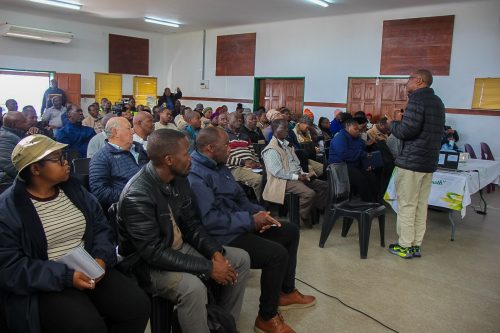

Participants posing for a group photo.
BY: PHESHEYA KUNENE – EDITOR
MANZINI – The Lake Agriculture National Maize and Beans Schools Competition showcased strong learner farming skills while the National Maize Corporation (NMC) warned that Eswatini spends over E500 million annually importing maize and beans.
Held at Mfanyana Hall in Manzini Central High School, the event brought together primary, junior secondary and senior secondary schools from across the country. Learners showcased harvested maize cobs, dry beans, agricultural production diaries, poetry compositions and participated in technical quizzes designed to test both theoretical knowledge and practical agronomic understanding.
The competition has grown into one of the most visible school-based agricultural platforms in the country, linking classroom learning with real production systems through Lake Agriculture seed varieties and structured school garden programmes.
Strong performances as schools battle for top honours
The competition produced clear winners across categories, reflecting increasing agricultural competence among learners.
At high school level, Sigangeni High School emerged as the overall winner, followed closely by Masibekela High School, while Esigangeni High School delivered strong performances across multiple categories, particularly in maize cob quality assessment and quiz sections.

Some of the winners posing with their prizes and medals.
At primary school level, Enhlanhleni Methodist Primary School was crowned overall winner after consistent performance across all evaluation areas, including production output, knowledge-based tasks and presentation components.
Masibekela High School dominated the agricultural diary and quiz categories, while Esigangeni High School excelled in maize cob evaluation. Other schools also performed strongly in bean production assessments and creative presentation segments.
Winning schools received Lake Agriculture seed inputs, trophies, medals, branded merchandise and in some cases farming equipment, aimed at strengthening their production capacity for future planting seasons.
NMC warns import dependence is costing over half a billion emalangeni
Farmer Development Officer Zakhele Nkonyane delivered a stark assessment of Eswatini’s grain sector, warning that the country’s reliance on imports continues to drain the economy.
He said Eswatini currently spends more than E500 million annually importing maize and beans due to persistent local production deficits.
Nkonyane explained that the country requires about 142,673 metric tonnes of maize per year, but only produces approximately 77,000 metric tonnes, resulting in a deficit of around 65,673 metric tonnes, valued at about E394 million.
In the case of beans, national demand stands at about 7,000 metric tonnes, while local production remains just above 1,000 metric tonnes, creating a shortfall valued at approximately E143 million.
“These figures show that Eswatini is still heavily dependent on imports for basic staples. We are importing food that we can produce locally if production is scaled and modernised,” Nkonyane said.

Enhlanhleni Methodist Primary school learners posing with their prizes after being named overall winners in the primary school level.
He further noted that the National Maize Corporation remains the key institution responsible for regulating maize imports and exports while supporting local production systems.
Farming presented as a viable youth business opportunity
Despite the production gap, NMC emphasised that agriculture remains a profitable sector, particularly for young people willing to engage in commercial production.
Nkonyane said maize production can yield gross margins of about E13,640 per hectare, while beans can generate up to E19,400 per hectare, depending on management practices and input efficiency.
He explained that maize farming typically costs around E21,000 per hectare, but can generate revenues exceeding E34,000, making it a viable business when properly managed.
“Opportunity is missed by most people because it is dressed in overalls and looks like work,” he said, urging learners to treat agriculture as a business rather than subsistence farming.
He also highlighted NMC’s support programmes, including contract farming, youth incubation initiatives, market and price assurance systems, mechanisation support and financing linkages through institutions such as EADF, EWADE, NDMA and YEF.
Lake Agriculture expands school farming footprint
Lake Agriculture Export Marketing Officer Robert Mathews said the company has invested approximately E300,000 into the programme and supplied nearly three tonnes of maize and bean seed to participating schools.
He said the initiative now involves more than 100 schools across Eswatini, with the long-term goal of strengthening practical agricultural education and building a pipeline of future commercial farmers.
Mathews said the programme is designed to move agriculture beyond theory, allowing learners to gain hands-on experience in crop production, record keeping, and agricultural marketing.
Education sector backs agriculture as strategic discipline
The Ministry of Education and Training’s School Agriculture Department expressed strong support for the initiative, noting that it aligns with Sustainable Development Goal 2 on Zero Hunger.
Speaking on behalf of the Senior Inspector, officials said agriculture educators remain central to inspiring learners to pursue opportunities in the agricultural sector and contribute to national food security.
The Ministry also confirmed that due diligence processes were followed and that the programme received formal approval prior to implementation.
Teachers and partners strengthen agricultural ecosystem
The Eswatini Agriculture Teachers Association (ESATA) was praised for initiating and expanding the competition nationally. Stakeholders called for further scaling of the programme to include all regions and strengthen learner participation across school levels.
Partner organisations such as Khuba Traders reinforced the importance of climate-smart agriculture, emphasising correct use of seed varieties, fertilisers, soil management and adaptation to changing climatic conditions.
Broader social and climate dimension introduced
UNESCO representatives used the platform to link agriculture with broader social development issues, urging learners to address bullying, promote mental health awareness and support gender equality.
They also highlighted climate change as a major factor reshaping agricultural production, calling for increased adoption of sustainable farming practices in schools and communities.
Conclusion: skills growing, gap widening
The Lake Agriculture National Maize and Beans Schools Competition has become a clear reflection of two realities. On one hand, it demonstrates rising agricultural skills among learners and growing enthusiasm for practical farming. On the other, it underscores a persistent national challenge, a food import bill exceeding E500 million annually driven by structural production deficits.
As winners celebrated their achievements, stakeholders reiterated a central message, Eswatini’s long-term food security will depend on transforming school-level agricultural talent into scalable, commercial production systems capable of reducing import dependence and strengthening national grain sovereignty.

Sigangeni High school learners and teachers posing with their trophies and prizes won at the Lake Agriculture National Maize and beans schools competition.