

BY PHESHEYA KUNENE – EDITOR
MANZINI – Eswatini faces a looming fertiliser shortage, with the government now seeking urgent funding from the African Development Bank to secure urea supplies and protect the country’s next planting season.
Minister of Finance Neal Rijkenberg confirmed that the Agriculture Department could soon run out of urea fertiliser, a development that threatens maize production, vegetable farming, sugarcane operations and national food security.
Speaking during his latest economic update, Rijkenberg said the government had already opened talks with the African Development Bank for a loan facility to cushion the country against rising fertiliser costs and possible supply disruptions caused by global instability.
“The Agriculture Department could soon run out of urea fertiliser, and that is not a risk we can afford to ignore. Agriculture remains the backbone of food security and rural livelihoods, and the government is taking deliberate steps to ensure farmers are protected from supply disruptions and escalating input costs,” said Rijkenberg.
He said the fertiliser challenge had moved beyond agriculture and now posed a direct economic risk to the country.
“If we fail to secure adequate fertiliser supply, we risk reduced national production, higher food prices, and serious pressure on household incomes. We are engaging the African Development Bank because protecting agricultural productivity is protecting the economy itself,” he said.
Rijkenberg said government had also established a stabilisation cushion to absorb part of the pressure caused by rising global fuel and fertiliser prices.
“The cushion is designed to endure for a considerable period, thereby ensuring Eswatini is not subjected to the full brunt of fuel price fluctuations,” he said.
Fertiliser is among Eswatini’s most critical agricultural imports. The country relies heavily on imported urea, ammonium nitrate and NPK blends, most of which enter through South African supply channels before reaching local distributors and farmers.

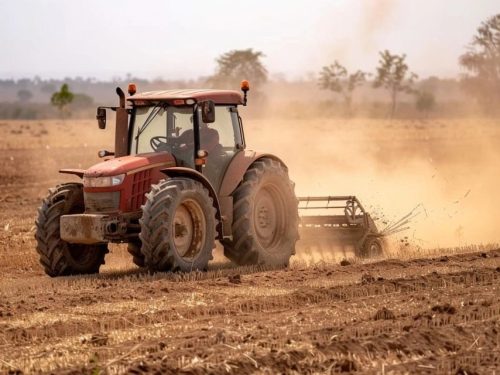
The Ministry of Agriculture estimates that more than 60 percent of Eswatini’s agricultural land suffers from nutrient depletion, making fertiliser essential for both subsistence and commercial farming. Without adequate fertiliser application, yields decline sharply, especially in maize, which remains the country’s staple crop.
Global logistics disruptions, rising fuel costs, foreign exchange pressure and geopolitical tensions affecting international shipping routes have pushed fertiliser prices upward, leaving many farmers unable to buy sufficient inputs.
To ease the pressure, the government has approved direct private imports of fertiliser to increase supply while continuing the Fertiliser Input Subsidy Programme aimed at helping smallholder farmers access inputs earlier in the season.
Principal Secretary in the Ministry of Agriculture Sydney Simelane said the threat was real and immediate.
“There will undoubtedly be substantial repercussions,” said Simelane.
He warned that disruptions linked to the Strait of Hormuz and other global shipping corridors could severely affect fertiliser imports into Southern Africa, with direct consequences for Eswatini.
“Between 30 and 40 percent of fertiliser imported through South Africa passes through vulnerable maritime routes. The immediate consequence will be a sharp escalation in fertiliser prices. Supply constraints are inevitable. A price shock will follow,” he said.
Simelane said farmers would likely reduce fertiliser application because of rising costs, resulting in weaker harvests and increased food insecurity.
“This is deeply regrettable because reduced fertiliser application will inevitably depress yields. Farmers will apply less than agronomically optimal, and that means harvests far below their potential,” he said.
He said the ministry was closely monitoring supply levels and working with importers, suppliers and development partners to prevent major disruptions before the next planting season.
“Our concern is no longer just food security, it is food sovereignty. We must ensure farmers have timely access to the right inputs so national production is not dictated by external shocks beyond our control,” said Simelane.
For farmers, the pressure is already being felt in the field.
ESNAU Chief Executive Officer Tammy Dlamini said fertiliser affordability had become one of the biggest threats to productivity and farm survival.
“When fertiliser becomes unaffordable, productivity drops, profitability disappears, and household food security is threatened. Farmers are already battling high fuel prices, expensive seed, transport costs and labour pressures. Fertiliser is now becoming another major burden,” said Dlamini.
He said urgent intervention was needed to protect both smallholder and commercial producers.
“We need stronger subsidies, stable supply chains and practical policies that keep farmers producing. If farmers reduce planting because they cannot afford fertiliser, the entire agricultural economy suffers,” he said.
Economist Sanele Sibiya said the fertiliser crisis could quickly spill into the wider economy through inflation and reduced agricultural output.
“When fertiliser supply is threatened, the first casualty is production, but the second is inflation. Lower yields mean tighter food supply, higher prices and greater pressure on already vulnerable households,” said Sibiya.
He said agriculture contributes about seven percent to Eswatini’s GDP, while nearly 70 percent of the population depends on the sector directly or indirectly.
“A fertiliser shock weakens agricultural GDP, reduces rural incomes and increases dependence on food imports. That creates inflationary pressure and widens economic vulnerability. This is not just an agriculture story, it is a national economic issue,” he said.
Sibiya said the government’s move to seek funding from the African Development Bank was necessary and timely.
“Securing fertiliser supply is not simply about farming, it is about protecting inflation stability, preserving food supply and safeguarding livelihoods. Delayed action would be far more expensive than intervention now,” he said.
With September and October planting preparations approaching, the fertiliser question is now urgent.
If supply fails, the consequences will be felt far beyond the farm, from supermarket shelves to household budgets. For the government, the race is no longer about policy discussion, it is about securing fertiliser before the next season arrives.