
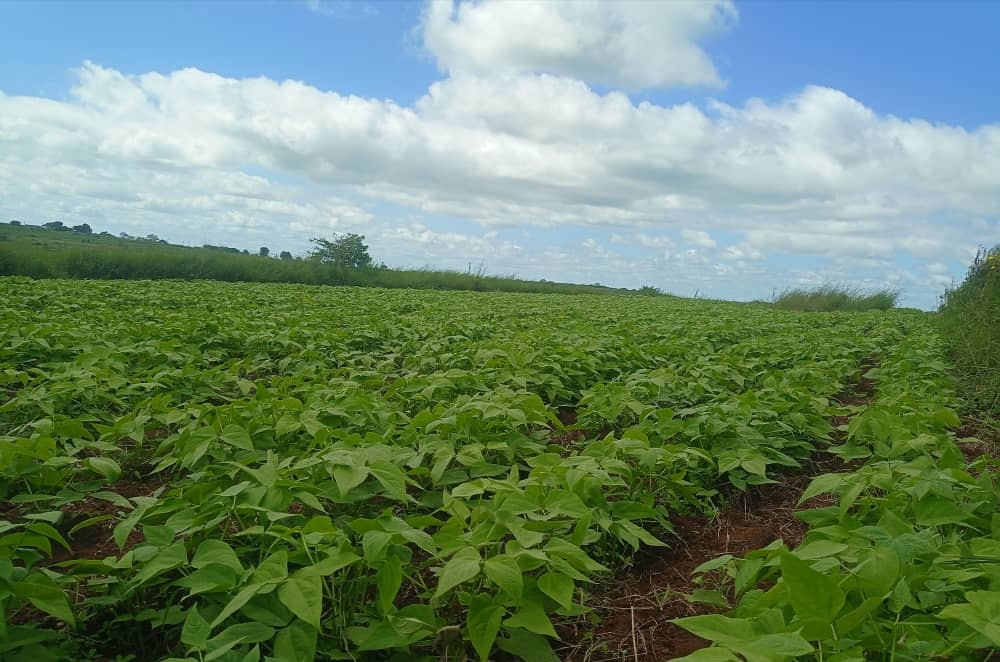
Bhekumusa Shiba’s 3-hectare bean field.
BY SIBUSISIWE NDZIMANDZE | JOURNALIST
MANZINI — In a sector where production risks and market uncertainties remain part of the farming cycle, young farmer Bhekumusa Shiba of Tikhuba under Matsanjeni North Inkhundla is demonstrating that resilience is a critical driver of sustainable agribusiness development.
Shiba, who is currently cultivating three hectares under dry bean production, has built his enterprise through persistence, adaptive management and strategic decision-making. He now supplies the National Maize Corporation (NMC), aligning his production with a structured and reliable market.
His farming journey dates back to 2009, when he began small-scale vegetable production, supplying cabbages to schools and local consumers. He later diversified into poultry production under the Makhaya chicken enterprise, where he maintained a flock of 50 hens and 10 cocks for breeding. However, his progress was disrupted by production and market-related constraints.

Bhekumusa Shiba, the young farmer in Tikhuba cultivating 3 hectares of beans (Pan 148 and Camba Manga)
He exited poultry farming after disease outbreaks, particularly Newcastle disease, led to high mortality rates within his flock. At the same time, unfavourable market conditions resulted in low farm-gate prices, making it difficult to recover feed and input costs.
In early 2025, Shiba ventured into dry bean production across three hectares as part of his efforts to stabilise his farming enterprise.However, on another one-hectare plot, he planted yellow maize, but the crop was severely affected by a heatwave that struck in February early this year, resulting in significant yield losses.
Despite this setback, he has continued to strengthen his bean enterprise, demonstrating resilience and a commitment to building a more sustainable farming operation.
Importantly, he adopted a market-oriented approach by first engaging the National Maize Corporation to secure an off-take arrangement before expanding production.
“They made themselves available and agreed that they would buy what I produce,” he said.
This shift reflects a clear opportunity within the bean value chain. Eswatini’s annual consumption of dry beans is estimated at 7,000 to 8,000 tonnes, while domestic production remains below 2,000 tonnes, resulting in a significant supply deficit largely met through imports.
For Shiba, this supply gap presents a viable entry point into a high-demand crop, reinforcing the importance of aligning production with market demand.
His current production system is rain-fed, exposing the crop to rainfall variability. However, he plans to invest in a furrow irrigation system, drawing water from a nearby river. Furrow irrigation will enable controlled water application along crop rows, improving soil moisture availability at critical growth stages and enhancing yield stability.
Shiba emphasised that resilience has been central to sustaining his enterprise.
“Resilience is important in farming because there are a lot of challenges you come across,” he said.
He also highlighted the value of working with extension officers, noting that their technical guidance has helped him improve his farming practices and enterprise decisions.
“Working with extension officers is very important because they give good advice on farming, and that helped me a lot,” he said.
Looking ahead, Shiba plans to diversify into dairy farming, while maintaining bean production as a core enterprise. This reflects a move towards enterprise diversification, aimed at spreading production risk and improving income stability.
His journey illustrates a key principle in modern agriculture: successful farming is not only about production, but about the ability to adapt, recover and reposition in the face of challenges.
In Tikhuba, Bhekumusa Shiba is demonstrating that resilience, combined with market alignment and improved production practices, can transform smallholder farming into a viable and growing agribusiness.