
BY SIBUSISIWE NDZIMANDZE | JOURNALIST
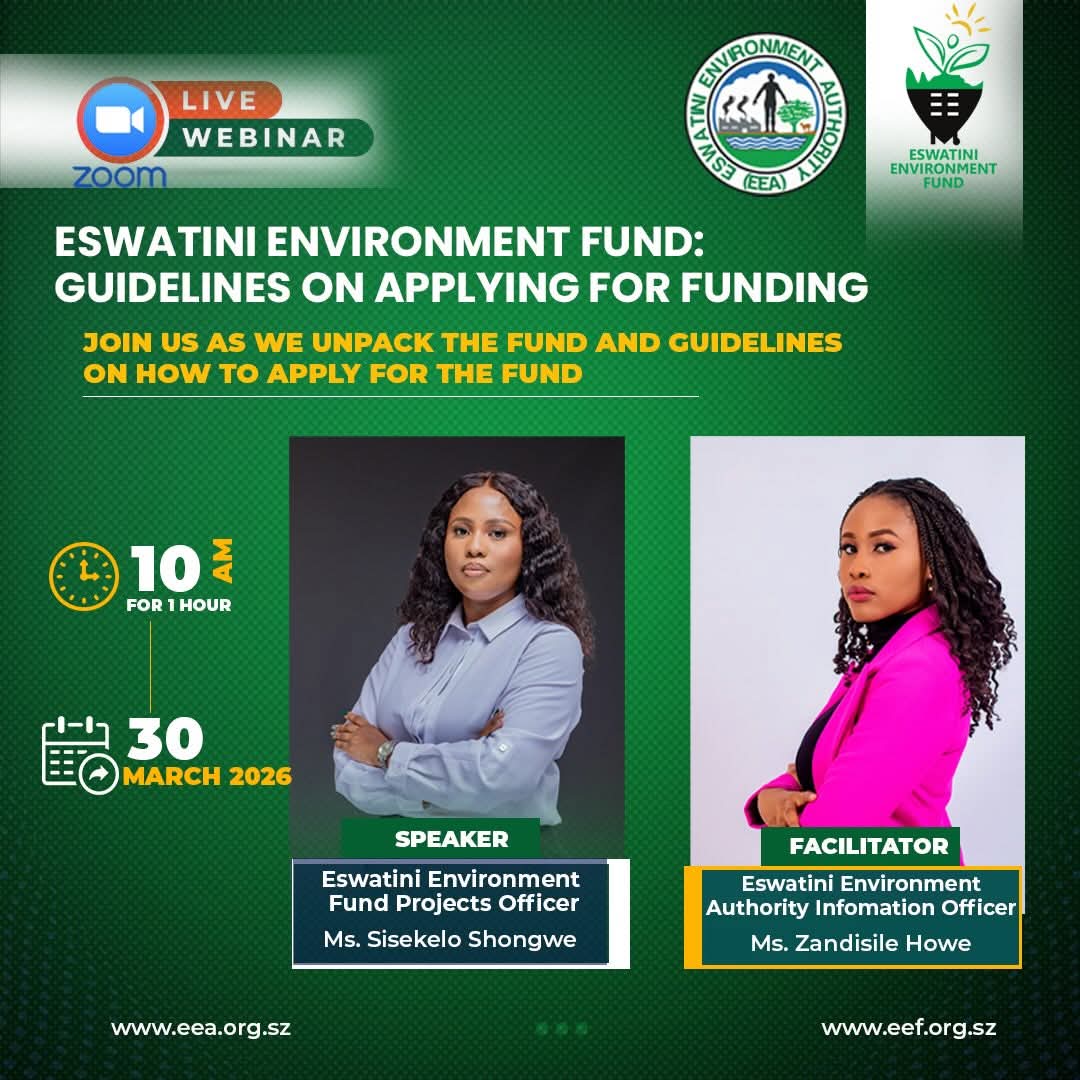
MANZINI — The Eswatini Environment Authority (EEA) will host a national webinar on 30 March 2026 aimed at guiding communities, farmers and organisations on how to access grants of up to E300,000 under the Eswatini Environment Fund (EEF).
According to information shared on the Eswatini Environment Authority’s official page, the online session, scheduled for 10:00 AM, forms part of efforts to help emaSwati better understand how to access funding under the 2025/2026 Eswatini Environment Fund cycle.
The Fund is currently open for applications, offering financial support for community-driven environmental projects responding to climate change, land degradation and water scarcity.
The webinar, titled “Eswatini Environment Fund: Guidelines on Applying for Funding,” will be led by Ms Sisekelo Shongwe, the Fund’s Project Officer, who is expected to unpack the application process, eligibility requirements and priority areas for funding.
The session is designed to equip potential applicants with practical knowledge to strengthen their proposals and improve access to one of Eswatini’s key grassroots environmental financing mechanisms.
The timing of the webinar is significant, as communities across the country face increasing pressure from erratic rainfall patterns, declining soil quality and growing exposure to climate shocks factors that continue to affect agricultural productivity and rural livelihoods.
The Eswatini Environment Fund, established under Section 20 of the Environment Management Act of 2002 and administered by the EEA, was created to mobilise resources for environmental protection, conservation and sustainable natural resource management.
Over the years, it has evolved into an important vehicle for community-led environmental action. More than 80 projects have already benefited from over E10 million in funding, supporting initiatives ranging from land rehabilitation and water management to biodiversity protection and waste management.
Among the notable interventions is the Yonge Nawe Manyeveni Land Rehabilitation Project in Kubuta, where degraded land was restored through erosion control, vegetation recovery, indigenous tree planting and livelihood activities such as beekeeping demonstrating how environmental restoration can directly improve household resilience.
For the current funding cycle, the Fund is focusing on five priority areas: sustainable land management; climate change adaptation and mitigation; sustainable water management; chemicals and waste management; and ecosystem and biodiversity protection.
These sectors are particularly critical for farmers, whose operations depend heavily on soil health, water availability and stable ecosystems.
The EEF is open to a wide range of applicants, including community-based organisations, NGOs, schools and youth groups, reflecting its focus on inclusive, grassroots-driven solutions.
Projects such as small-scale irrigation, catchment protection, soil conservation, wetland restoration, rangeland improvement and recycling initiatives are among those that stand to benefit.
Applicants are required to submit detailed proposals, including project concepts, beneficiary information and local authority approvals. The Fund also requires that at least 80 percent of the grant be directed towards environmental action, ensuring that resources translate into tangible impact on the ground.
For the 2025/2026 cycle, government has allocated E2 million to support innovative environmental solutions, with the application deadline set for 16 April 2026.
The upcoming webinar is expected to play a critical role in bridging the information gap, particularly for first-time applicants and groups that may have viable ideas but limited experience in grant applications.
Interested participants can join the webinar using the link below:
Join Zoom Meeting: https://us05web.zoom.us/j/89075023169?pwd=la3xqf2apaTjZ2vD8rdiAoNJeHk8sG.1
As Eswatini continues to confront environmental and climate-related challenges, the EEF supported by initiatives such as this webinar is positioning itself as a practical tool for communities to turn local challenges into sustainable, community-led solutions.