
Foot and Mouth-Disease (FMD) Vaccination Progress in Eswatini
BY SIBUSISIWE NDZIMANDZE | JOURNALIST
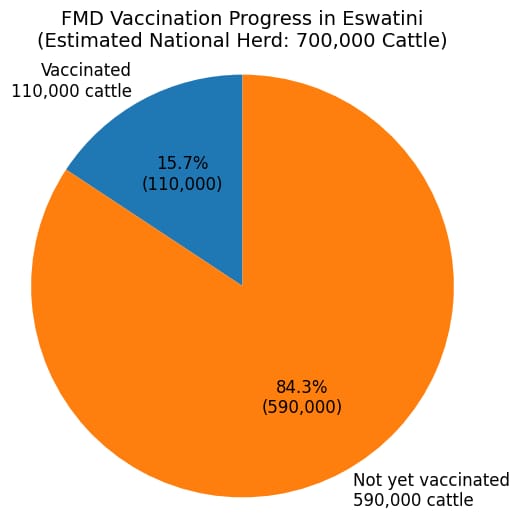
MANZINI – Eswatini has vaccinated about 110 000 cattle against Foot and Mouth Disease (FMD) since the latest national mass vaccination campaign began three weeks ago, in what government sees as a critical step toward protecting the country’s estimated 700 000-head national herd from further outbreaks.
But even as vaccination numbers rise, authorities insist that checkpoints and strict animal movement controls must remain in place.
In an interview with Eswatini TV, Minister of Agriculture Mandla Tshawuka said the progress made so far was encouraging, but warned that vaccination alone would not defeat the outbreak if livestock movement was relaxed too early. The minister argued that checkpoints remain a critical part of the response because vaccines do not remove the risk of fresh exposure in an environment where uncontrolled animal movement remains a threat.
That position is now at the centre of growing public and political debate. Just days ago, Members of Parliament questioned why government was still spending on checkpoints while vaccination campaigns were already under way in Eswatini and neighbouring South Africa. The issue was raised during debate on the Ministry of Agriculture’s annual performance report before the House of Assembly Portfolio Committee.
For government, however, the answer appears clear: vaccination without continued movement control could allow the virus to circulate back into treated areas, undermining the gains already made.
The latest push comes as Eswatini continues battling an outbreak that has weighed heavily on the livestock sector since it was first detected in May 2025. By late January 2026, reports indicated that the disease had spread from Shiselweni into parts of Lubombo and Manzini, with Hhohho then remaining the only region still free of reported cases.
Vaccination, meanwhile, has been gathering momentum. Earlier this month, reports showed that more than 18 000 cattle had already been vaccinated nationwide as the campaign accelerated, with veterinary teams deployed across the country to increase coverage. The current figure of about 110 000 cattle vaccinated, if sustained, would signal a sharp escalation in the pace of the operation.
Government’s strategy is not built on vaccines alone. Foot and Mouth Disease is a highly contagious transboundary livestock disease affecting cattle, pigs, sheep, goats and other cloven-hoofed animals, and its consequences extend far beyond animal health. The disease disrupts production, threatens farmer incomes and can severely affect local and export trade in livestock and livestock products.
That is why countries fighting FMD typically combine vaccination, movement restrictions, surveillance and biosecurity enforcement rather than relying on a single intervention. Regional reporting from southern Africa has repeatedly reinforced the same message: movement controls remain a core disease-management tool even after vaccination has started.
Eswatini has already committed major resources to the fight. Earlier reports said government had allocated about E90 million to the FMD response, including vaccination and related containment measures. Earlier in February, the country received an initial 70 000 doses of vaccine, with another 50 000 doses expected shortly afterwards as part of the phased national rollout.
The broader regional context has made procurement even more urgent. Southern Africa is facing multiple outbreaks, with South Africa also ramping up emergency vaccination after the spread of FMD across all nine provinces. South Africa has sourced vaccine consignments from international suppliers as it tries to contain its own crisis, highlighting just how tight and competitive the regional vaccine market has become.
With hundreds of thousands of cattle still needing protection, the country faces a significant logistical challenge to expand vaccination coverage, deliver booster doses and maintain strong disease surveillance. At the same time, porous borders and illegal livestock movement continue to threaten progress if strict controls are not maintained.
Farmers have therefore been urged to cooperate fully with vaccination teams, observe checkpoint rules and avoid illegal livestock movement.
The government’s message is that vaccines are essential, but they will not succeed on their own.
For now, the ministry’s stance is unmistakable: if Eswatini is to bring the outbreak under control, protect farmer livelihoods and restore confidence in the livestock sector, the country will need more than needles in the field. It will require discipline at checkpoints, strict movement control, reliable vaccine supply and continued surveillance.