BY: PHESHEYA KUNENE | EDITOR
LUYENGO — At 32, Jerome Hlatshwako has already learnt one of commercial farming’s toughest lessons: a good harvest does not automatically mean a profitable farm.
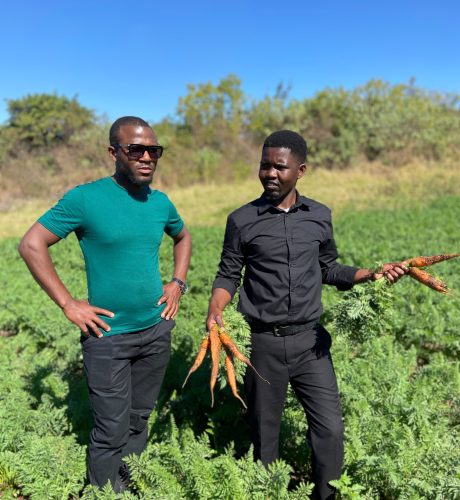
The young agripreneur behind Mega Fold Harvest, a four-hectare horticulture enterprise at Emanyeveni, Luyengo, produces carrots, lettuce, cabbages, spinach and green beans, employs about 10 casual workers and supplies produce through NAMBoard and retailers including OK Foods.
But his journey has included hailstorms, market oversupply and costly mistakes. Rather than pushing him out of agriculture, the setbacks have shaped how he farms today.
E1000 STARTED THE JOURNEY
Hlatshwako grew up at Bhadzeni II in a household where neither parent had formal employment.
“Growing up in that atmosphere, I learnt at an early age to fight for survival,” he said.
After completing high school in 2014, he initially failed to secure admission to university or college. A gap year followed, and with it came farming.
What began as a backyard garden developed into small-scale production. His starting capital was just E1 000 from his personal allowance.
“I made a loss and started afresh many times,” he said.
In 2017, Hlatshwako enrolled at the University of Eswatini for a BSc in Agricultural Economics and Agribusiness Management, completing his degree in 2022.
The qualification changed how he viewed farming. A field was no longer simply somewhere to plant. It became a business requiring budgeting, record-keeping, production planning, costing and market analysis.
LOSSES BECAME HIS CLASSROOM
His most expensive education, however, came from the farm itself.
In 2023, heavy hailstones caused losses of about E10 000. In 2024, he lost another E8000 after misreading demand and supply patterns.
Then, in 2025, an oversupplied market pushed prices down, contributing to another loss of approximately E15 000.
That is about E33 000 in losses over three years.
The experience taught him an important distinction: production risk and market risk are not the same thing.
A farmer can produce an excellent crop and still lose money if too much of the same produce reaches the market simultaneously.
NAMBoard’s market-extension services emphasise information on demand, prices, production planning and consumer trends. For growers, that makes market research almost as important as soil preparation.
Hlatshwako learnt it the hard way: know your market before filling your field.
LETTUCE KEPT THE BUSINESS MOVING
Before carrots moved to the centre of his expansion plans, lettuce was his cash crop.
“I have been a lettuce producer for quite some time, and that is the vegetable that put my name in the spotlight in the market,” he said.
Income from lettuce helped sustain him while Mega Fold Harvest remained largely an ambition. At one stage, lettuce generated about E7 000, part of which he reinvested into developing the enterprise.
NAMBoard became part of his journey in 2023, helping him strengthen market relationships. Hlatshwako later approached OK Foods and secured an opportunity to supply fresh produce.
For emerging farmers, his experience offers another practical lesson: do not wait until harvest to start looking for buyers.
Know the required volumes, quality standards, delivery schedules and likely prices before planting.
CARROTS MOVE TO THE CENTRE
Carrots are now emerging as an important part of Mega Fold Harvest’s future.
“Carrots becoming a scarce crop locally triggered me to think beyond my capability in knowledge and finance,” Hlatshwako said.
He describes the crop as labour-intensive but potentially high-return.
The opportunity is particularly relevant as the country seeks to replace imported horticultural produce with locally grown alternatives.
Yet demand alone does not guarantee profit.
Carrots require careful field preparation. They generally perform best in loose, well-drained soils, which allow roots to develop properly. Compacted or poorly prepared soils can contribute to misshapen roots, reducing marketable quality.
Water management, weed control, plant nutrition and correct planting density also matter.
The lesson for growers considering carrots is straightforward: a market shortage is an opportunity only if the farmer can consistently produce the quality and volumes buyers require.
CLIMATE CHANGE ADDS ANOTHER CALCULATION
Hlatshwako’s E10 000 hailstone loss demonstrated how quickly weather can rewrite a farm budget.
Vegetable farmers increasingly have to contend with heatwaves, dry spells, irregular rainfall and destructive storms.
“One of the most relevant ways to approach climate change is to invest in studying climate patterns for a few years before going big,” he said.
For horticulture, climate-smart production can include efficient irrigation, water conservation, soil management, crop rotation, appropriate planting windows and diversification.
Hlatshwako’s philosophy is to understand both the climate and the market before expanding aggressively.
DIVERSIFY OR CARRY THE RISK
His setbacks have also changed how he thinks about crops.
“I learnt the hard way that you never put all your eggs in one basket,” he said. “Diversity is important in agribusiness to reduce shocks.”
Mega Fold Harvest now spreads production across carrots, cabbages, spinach, lettuce and green beans.
Diversification can spread commercial risk, while planned crop rotation can help farmers manage soil health and some pest, disease and weed pressures.
But planting several crops is not enough. Each crop needs a commercial reason for being in the field.
Who will buy it? What volume is required? What will it cost to produce? When should it reach the market? And what price makes it worthwhile?
Those are questions Hlatshwako believes farmers should answer before planting, not after harvesting.
BIGGER DREAMS BEYOND FOUR HECTARES
Four hectares are only the beginning.
Hlats
hwako wants Mega Fold Harvest to become a leading vegetable producer and distributor, with processing and packaging already part of his longer-term plans.
His journey provides a useful reality check for young people attracted to agriculture.
He started with E1000, suffered repeated losses, went to university, returned to farming, established markets and continued reinvesting. At 32, he is still learning.
And that may be the most valuable part of his story.
Commercial farming is not simply about putting seed into soil and waiting for money to grow.
It is about knowing the soil, understanding the weather, calculating costs, finding markets, managing risk, diversifying production and learning quickly when things go wrong.
Hlatshwako’s four hectares therefore offer a lesson considerably bigger than the farm itself.
Grow what the market needs, grow it to the standard buyers demand, and know where it is going before it leaves the ground.