
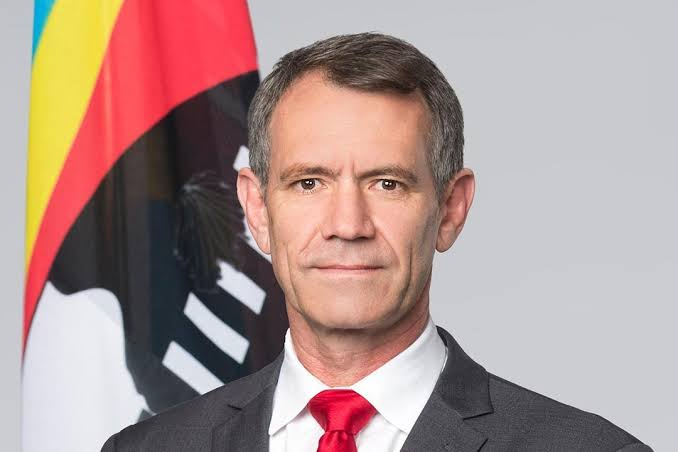
Minister of Finance Neal Rijkenberg
BY: NOSIPHO MKHIZE | JOURNALIST
MBABANE – Government’s fiscal reforms have significantly strengthened Eswatini’s economic standing, cutting the fiscal deficit, stabilising public debt and rebuilding investor confidence, Minister of Finance Neal Rijkenberg says.
Speaking in the latest edition of Finance in Focus video series, Rijkenberg said the reforms have shifted international perceptions of Eswatini from a high-risk economy to one increasingly viewed as an attractive investment destination.
The reform package, implemented between 2018 and 2020, was designed to address long-standing structural weaknesses that had constrained growth for nearly two decades.
“For almost 20 years before the COVID-19 pandemic, Eswatini recorded average economic growth of about two percent annually. While that represents positive growth, it was far too low to create enough jobs, reduce poverty and improve the quality of life for emaSwati,” he said.
Why fiscal health matters to investors
Rijkenberg explained that international investors and development finance institutions closely monitor a country’s fiscal position before committing capital, relying heavily on assessments by the International Monetary Fund (IMF), the World Bank and sovereign credit rating agencies.
These institutions, he said, had consistently flagged concerns over Eswatini’s large public sector wage bill, widening fiscal deficits, rising public debt, dependence on volatile Southern African Customs Union (SACU) revenues and weaknesses in expenditure management.
In response, the government introduced a package of fiscal consolidation measures aimed at repairing public finances and strengthening the economy’s fundamentals.
Deficit down, wage bill contained
Among the most significant achievements, Rijkenberg said, was the reduction of the fiscal deficit from approximately 7.5 percent of Gross Domestic Product (GDP) to about 2 percent — a signal of stronger fiscal discipline and improved management of public finances.
The government wage bill has also fallen sharply, from around 42 percent of total government expenditure to approximately 32 percent, achieved through a hiring freeze and tighter expenditure controls. Following a recent salary review, the ratio has edged up to about 33 percent, but remains well below previous levels.
“Government remains committed to gradually reducing this ratio even further over the coming years,” he said.
Public debt, he noted, has been stabilised at around 40 percent of GDP — a level he described as manageable and consistent with fiscal sustainability.
“Maintaining debt at a stable and manageable level is a key indicator of a sustainable fiscal path and provides confidence to investors and lenders,” he said.
E1.5 billion buffer against SACU shocks
To cushion the country against fluctuations in SACU receipts, the government established the SACU Stabilisation Fund, which currently holds approximately E1.5 billion. Rijkenberg said the fund acts as a financial buffer, allowing the government to absorb unexpected declines in SACU revenues without destabilising public finances.
Expenditure discipline has also been tightened, with spending kept within approved budget allocations.
“For several consecutive years, government expenditure has remained below budget, reinforcing confidence in Eswatini’s fiscal management,” he said.
Shifting the international narrative
Beyond the numbers, Rijkenberg said the government has actively engaged international institutions to explain Eswatini’s governance framework, arguing that misconceptions about the country’s political system had previously coloured external assessments.
These engagements, combined with improved fiscal management, have contributed to more balanced international evaluations of the economy, he said.
“The reports have not suddenly become overwhelmingly positive, nor do they suggest that every challenge has been resolved. However, the overall narrative has shifted from portraying Eswatini as a high-risk or largely uninvestable economy to recognising it as an increasingly investable country with improving fiscal fundamentals.”
The improved credibility, he said, has expanded opportunities for international financing and investment, even though lending standards remain rigorous.
Growth with discipline
Looking ahead, Rijkenberg said the government’s priority is to sustain economic growth while maintaining prudent fiscal management, cautioning that borrowing must remain aligned with the country’s growth trajectory.
“Our objective is to continue growing the economy while maintaining responsible fiscal management. The government must avoid accumulating excessive debt that could undermine future growth,” he said.
A stable macroeconomic environment, he added, would encourage private sector investment, business expansion and job creation.
“As the economy grows, our Gross Domestic Product increases, improving the country’s debt-to-GDP ratio and creating greater fiscal space for productive infrastructure and development projects. Ultimately, our goal is to keep Eswatini on a sustainable fiscal path, strengthen confidence in our economy, attract investment, create jobs and improve the lives of all emaSwati.”