

…Partnership between a family-owned farm, UNESWA and the Ministry of Agriculture is showing how research, improved varieties and commercial farming can raise productivity, strengthen food security and create wealth for farmers.
BY: PHESHEYA KUNENE | EDITOR
BIG BEND – On most farms, research arrives long after the planting season has ended, tucked away in academic journals, research papers and conference presentations that few farmers ever read. At KaGule Enterprise in Qokwane, however, research grows alongside the crops.
The neatly planted rows of sweet potatoes stretching across the family-owned farm are doing far more than producing food. They are testing improved varieties, evaluating modern production methods and helping researchers understand how biotechnology performs under real farming conditions. At the same time, they are giving farmers something often missing from agricultural advice — evidence.
That transformation is the result of a partnership between KaGule Enterprise, the University of Eswatini’s (UNESWA) Horticulture Department and the Ministry of Agriculture’s Department of Agricultural Research and Specialist Services (DARSS). Together, they have turned a commercial farm into a living research and demonstration site where science is tested under the same conditions faced by ordinary farmers.
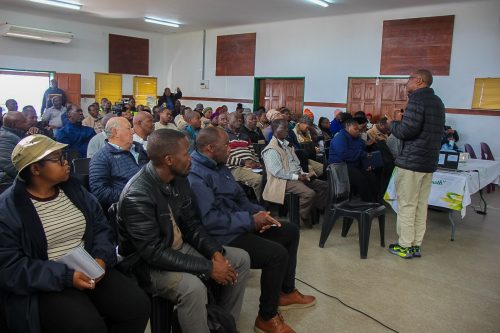
The partnership was showcased during the Biotechnology Sweet Potato Farmers’ Field Day, organised by UNESWA in collaboration with DARSS. The initiative introduced farmers to tissue culture-produced orange-fleshed sweet potato varieties, production and management practices, biotechnology, nursery establishment and value addition while allowing them to engage directly with researchers and extension specialists.
Yet beneath the field demonstrations lay a broader question confronting Eswatini’s agricultural sector: how can research move beyond laboratories to help farmers produce more, earn more and farm more sustainably?
A FAMILY FARM WITH A BIGGER PURPOSE
The answer may lie at KaGule Enterprise.
The farm, founded by veteran farmer S.M. Gule and now managed by his son Ngangelive Gule, has evolved from a family vegetable enterprise into a centre of agricultural innovation.
Instead of simply producing crops for the market, Gule opened his fields to researchers from UNESWA and DARSS, creating an environment where improved sweet potato varieties could be evaluated under commercial farming conditions.
Researchers supplied planting material, technical guidance and scientific support, while the farm contributed land, labour and daily management.
For Gule, the arrangement benefits everyone.
“We are learning alongside the researchers,” he explained during the field tour. “We plant the different varieties, monitor their performance and see first-hand which ones are best suited to our conditions.”
That knowledge, he believes, should not remain on his farm.
Throughout the day, neighbouring farmers moved from plot to plot comparing six improved sweet potato varieties, including Super Margaret, Cecilia, Alisha and Melinda. They examined plant vigour, discussed disease tolerance and asked researchers about spacing, irrigation and expected yields.
The farm had become exactly what its partners intended — a classroom without walls.
RESEARCH THAT PRODUCES RESULTS
For years, one of the biggest criticisms of agricultural research across Africa has been the gap between scientific discoveries and adoption by farmers.
Technologies often perform well inside research stations but fail to reach the people expected to use them.
The partnership at KaGule Enterprise attempts to close that gap.
Rather than asking farmers to trust recommendations on paper, researchers are demonstrating improved technologies under practical field conditions.
Leading those demonstrations was researcher and sweet potato farmer Baring Nkambule, who urged farmers to adopt proper planting techniques if they wanted higher yields and stronger returns.
He explained that success begins with healthy planting material, properly prepared ridges, recommended spacing and consistent crop management.
Sweet potato, he added, offers commercial farmers an attractive opportunity because it generally requires lower production costs than many field crops while delivering favourable gross margins.
“The right technique gives you the right harvest,” he told participants.
Nearby, Nhlanhla Hlophe, a Roots Crops and Tubers Research Officer based in Big Bend, guided farmers through the six varieties, explaining how each performs under Lubombo conditions and why variety selection should depend on production objectives, local soils and market demand.
The demonstrations reinforced a simple but often overlooked reality.
The quality of the harvest is determined long before harvest begins.
FROM HARVEST TO HIGHER VALUE
While improving production remains essential, researchers argued that profitability depends equally on what happens after harvest.
During the food demonstration session, Ministry of Agriculture Food and Technology Research Officer Nokuthula Dlamini transformed sweet potatoes into flour, muffins, juice, chips and other products, showing farmers how value addition can unlock new income streams.
For many participants, it was the first time seeing sweet potato marketed as more than a fresh crop.
Processing and product diversification, Dlamini explained, allow farmers to capture greater value, reduce post-harvest losses and respond to changing consumer demand.
The lesson was clear: the value chain does not end in the field.
KNOWLEDGE IS THE BEST INPUT
Elsewhere on the farm, Gule used his tomato fields to illustrate another challenge confronting farmers.
Choosing the wrong pesticide, he warned, can destroy a crop instead of protecting it.
Drawing on his own experience, he encouraged farmers to consult agricultural retailers such as SAS and Farm Chemicals before purchasing agrochemicals and to seek guidance from extension officers rather than relying on trial and error.
His advice was echoed by NAMBoard Extension Officer Ernest Matsebula, who called on farmers to make greater use of extension services.
From selecting seed to applying fertiliser and controlling pests, he said, technical advice remains one of the most valuable inputs available to farmers.
“Our doors are always open,” Matsebula said. “We want farmers to grow beyond production and become successful agripreneurs.”
BUILDING BUSINESSES, NOT JUST FARMS
Modern agriculture also requires finance.
Recognising that reality, Eswatini Bank participated in the field day to explain agribusiness financing opportunities available to farmers wishing to establish or expand commercial enterprises.
Agribusiness Officer Mlungisi Dlamini encouraged producers to engage the bank early, understand available loan products and develop viable business plans before investing.
The message aligned with the day’s broader theme.
Improved seed, research and technical knowledge achieve little without access to finance capable of supporting commercial growth.
ATTRACTING THE NEXT GENERATION
The event also highlighted a growing national concern — the future of farming itself.
Representing the Ministry of Agriculture’s Under Secretary, Vincent Dlamini said Eswatini must strengthen food sovereignty by producing more of its own seed, adopting improved varieties and ensuring research reaches farmers.
More importantly, he argued, agriculture must create wealth.
Young people, he warned, are increasingly turning away from farming because they do not see it as a profitable career.
If agriculture is to compete with other industries, successful commercial farmers must become the sector’s strongest ambassadors.
That message resonated with Nkilongo Member of Parliament Petros Sibandze, who encouraged farmers from his constituency to embrace agriculture as a business capable of creating employment, improving household incomes and driving rural development.
His appeal reflected a growing recognition that farming must be viewed not simply as a livelihood, but as an enterprise.
SCIENCE IN THE SERVICE OF FARMERS
The significance of the partnership at KaGule Enterprise extends beyond sweet potatoes.
It demonstrates how universities, government researchers, extension officers, financial institutions and commercial farmers can work together to solve practical problems facing agriculture.
For farmers, the benefits are tangible.
Improved varieties increase productivity.
Better planting techniques reduce risk.
Extension support improves decision-making.
Finance enables expansion.
Value addition creates new markets.
Together, they strengthen profitability and resilience.
As participants departed KaGule Enterprise, they carried home more than technical information.
They left with a clearer understanding that modern agriculture is no longer driven by hard work alone.
It is driven by knowledge, partnerships and innovation.
The sweet potatoes growing at KaGule Enterprise are, in many ways, only the beginning.
The more important harvest may well be a new way of thinking about farming in Eswatini—one in which research no longer ends at the laboratory door but begins where it matters most: in the farmer’s field.