

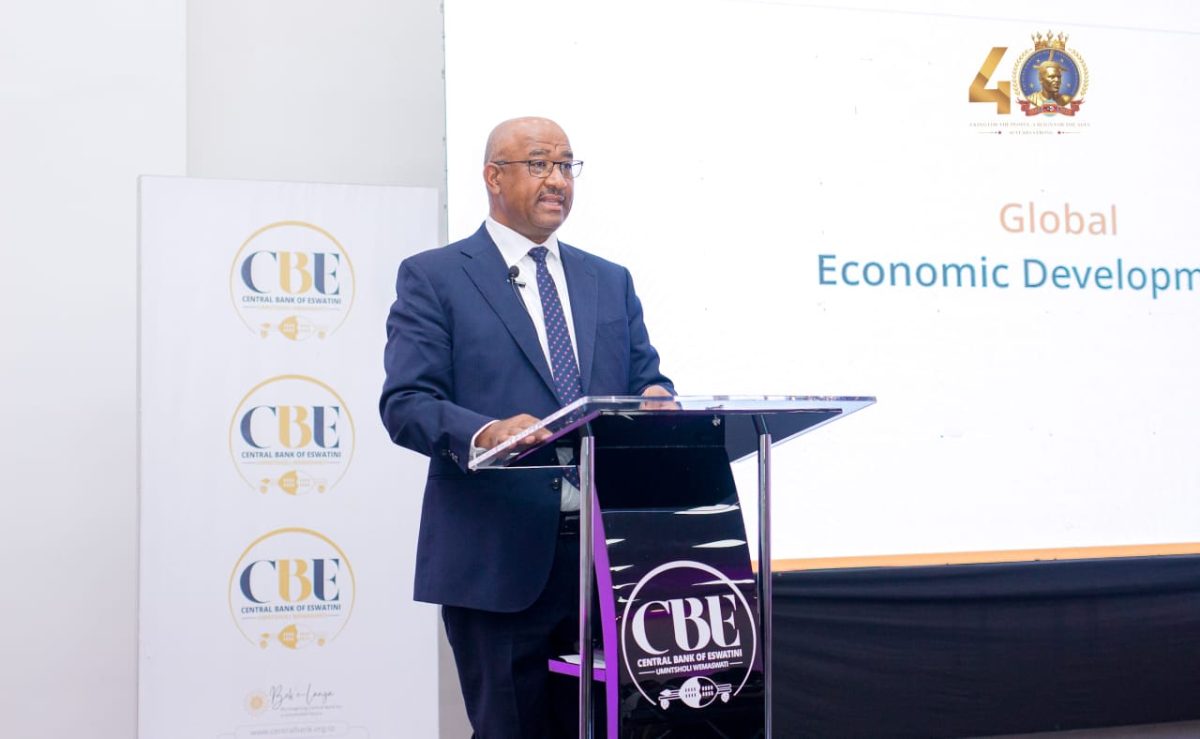
Central Bank of Eswatini Governor Dr Phil Mnisi delivering his annual policy statement report.
BY PHESHEYA KUNENE – EDITOR
EZULWINI – Eswatini’s economy expanded by 5.6% in 2025, but rising global tensions, Foot and Mouth Disease outbreaks and mounting fuel costs are beginning to cast a long shadow over the country’s growth outlook.
This emerged during the Governor’s Annual Monetary Policy Statement delivered by Central Bank of Eswatini Governor Dr Phil Mnisi at the CBE Complex in Ezulwini on Thursday, where senior government officials, Members of Parliament, financial sector executives and business leaders gathered to assess the country’s economic direction amid an increasingly volatile global environment.
Presenting the statement under the theme “Monetary Policy in a Time of Uncertainty and Heightened Geopolitical Tensions,” Dr Mnisi said Eswatini remained vulnerable to external shocks due to its close economic integration with South Africa and exposure to global commodity and financial markets.
“The domestic economy is projected to grow by 5.2% in 2026 and 3.9% in 2027. Risks to the outlook include international trade uncertainty, geopolitical tensions which could cause supply chain disruptions, erratic weather conditions, the Foot and Mouth Disease outbreak, as well as fiscal pressures,” said the Governor.
Dr Mnisi warned that the FMD outbreak continued to disrupt livestock production, agricultural trade and supply chains, placing additional strain on farmers and agribusinesses already grappling with rising operating costs.
He noted that escalating tensions in the Middle East were exerting upward pressure on global oil prices, with likely spillover effects on transport costs, fertiliser prices and food inflation across the region.
“The fluid geopolitical environment continues to exert upward pressure on energy prices, while disruptions to farm input supplies and fertiliser risks may amplify food inflation,” he said.

Despite these pressures, the Governor said the domestic economy had demonstrated resilience during 2025, supported largely by strong performance in the tertiary sector, which rebounded sharply to 7.6% growth from 1.2% in the previous year.
Inflation moderated significantly from an average of 3.9% in the 2024/25 financial year to 2.6% in 2025/26, largely due to easing international food and oil prices. However, the Central Bank now projects inflation to rise to 3.3% during 2026 as global cost pressures intensify.
Dr Mnisi said the Central Bank maintained a slightly accommodative monetary policy stance throughout the review period, keeping the policy rate at 6.75% after gradual reductions aimed at supporting economic activity and credit expansion.
Private sector credit continued to strengthen, rising to E23.2 billion by March 2026, driven mainly by increased lending to businesses and improving household demand.
“About three years ago, credit extended to the private sector was around E15 billion. This has been phenomenal growth in the banking sector,” said the Governor.
The banking sector, he added, remained stable, well-capitalised and highly liquid, with commercial banks maintaining liquidity ratios comfortably above regulatory minimum requirements.
Dr Mnisi further revealed that the country’s gross official reserves reached a historic peak of E15.5 billion in November 2025 before easing to E10.2 billion by April 2026 due to increased foreign exchange outflows and government obligations.
In a move aimed at strengthening reserve diversification and financial stability, the Central Bank also acquired 2,500 ounces of gold valued at approximately E190.5 million.
“In light of global practice, the Bank is exploring avenues to increase its gold holdings through purchases from local production,” he said.
The Governor also announced the introduction of a Trade Verification System being developed in partnership with the Eswatini Revenue Service and Common Monetary Area member states.
The system is expected to automate the verification of customs declarations against cross-border foreign exchange transactions in an effort to curb illicit financial flows, trade mis-invoicing and foreign exchange leakages.
Climate change emerged as another major concern during the address, with Dr Mnisi warning that increasingly unpredictable weather patterns were becoming a growing economic and financial threat.
“Climate change is real,” he said. “Who would have thought that in the middle of April, when we should be behind the fire, we would experience torrential rains damaging homes?”
Minister of Finance Neal Rijkenberg, who also attended the event alongside the Speaker of Parliament, Senate President and senior government officials, echoed concerns around economic resilience and financial stability. He highlighted government efforts aimed at strengthening financial systems and addressing emerging threats such as cybercrime and illegal gambling.
While the Governor maintained that the country’s financial sector remained sound and resilient, he cautioned that the global outlook remained fragile and uncertain.

“The future path of policy rates will remain data-driven,” Dr Mnisi said. “Global developments and their impact on the domestic economy will continue to shape our decisions.”
Economists say the Governor’s statement reflects an economy that remains resilient on paper, but increasingly exposed to external shocks and structural vulnerabilities.
Commenting on the report, experienced Eswatini economist Sanele Sibiya said the country’s 5.6% economic growth was encouraging, particularly amid global instability, but warned that rising fuel costs, climate shocks and the FMD outbreak could quickly erode gains in agriculture and consumer spending if not managed carefully.
“The Governor’s report shows that Eswatini has made progress in stabilising inflation, strengthening reserves and supporting private sector credit growth. However, the biggest concern now is sustainability. Agriculture, transport and food systems are under pressure from both climate change and global geopolitical tensions. The country now needs stronger productivity-driven growth, investment in local production and tighter protection of strategic value chains,” said Sibiya.