BY SIBUSISIWE NDZIMANDZE AND SIKHONA SIBANDZE | JOURNALISTS
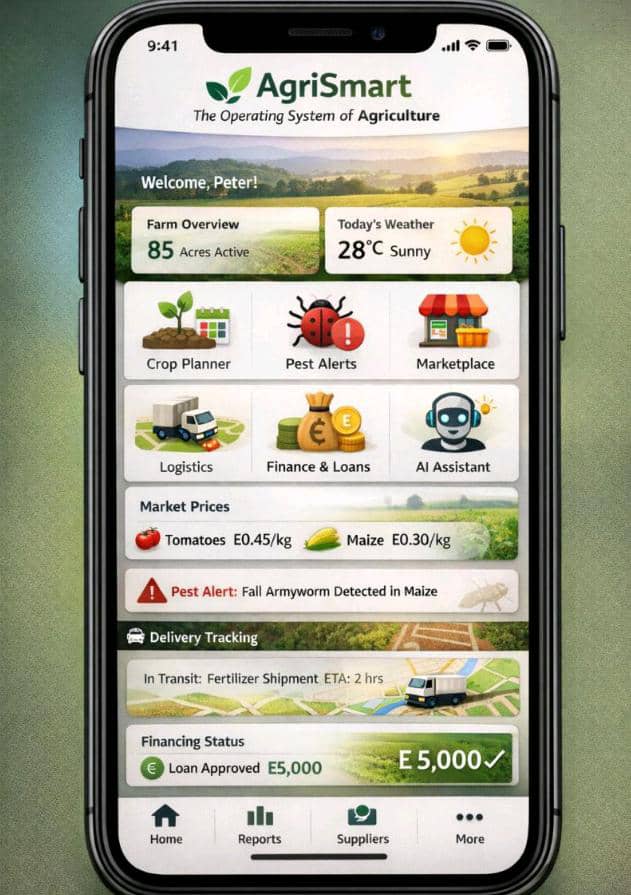
MANZINI – The future of farming in Eswatini is becoming digital. As farmers face rising input costs, climate shocks and growing disease threats, a new platform called Agriculture Smart AI (ASA) is preparing to launch an app designed to help farmers manage their operations smarter, faster and with better information.
Agriculture Smart AI (ASA) is a digital agriculture platform built to help farmers manage crops, livestock, suppliers, logistics and finance in one intelligent system. The platform is currently awaiting launch through partnerships with key stakeholders, including suppliers and institutions such as banks and government agencies.
ASA founder and project manager, Celumusa Thusi says the platform is designed to empower farmers with practical tools that change agriculture from survival to sustainable business. “ASA was built to give farmers clarity, confidence, and control. When farmers have the right tools and information, agriculture stops being a struggle and becomes a business,” he says.
Breaking barriers for farmers
For years, many farmers have relied on notebooks, memory, delayed updates and informal networks to run their farms, often losing time and money when problems arise unexpectedly. ASA says it was created after observing that farmers work extremely hard, yet still lose value due to gaps in data, market access, logistics and expert support. The platform’s approach is to bring fragmented services into one connected ecosystem, linking farming operations with suppliers and logistics, supported by AI-driven insights.
“Track your farm even when you’re away”
A major feature of ASA is its focus on practical, day-to-day decision support. Farmers will be able to upload photos of crops or livestock, ask questions, and receive AI-supported guidance aimed at early disease detection and better decisions.
In real terms, this means a farmer managing cabbages, whether at home, at work, or away from the field, can still track what is happening on the farm. If disease symptoms appear on cabbages, the farmer can consult the AI for guidance, including possible treatment options and what pesticides may be appropriate for that specific problem, helping farmers respond faster and save time.
More than a marketplace, an operating system for agriculture
Thusi says the platform is not designed as a simple marketplace or basic record book. Instead, ASA is positioned as “an operating system for agriculture,” supporting farmers across the cycle, from planting to selling.
This includes helping farmers build a consistent digital track record of their daily activities, creating clearer farm histories that can support better planning, productivity monitoring and business decision-making.
Government updates and early warnings in one place
ASA also aims to partner with the Government to strengthen farmer communication by integrating verified public information into the platform. The goal is to ensure farmers can access critical updates in one place such as:
- alerts on outbreak diseases like Foot and Mouth Disease (FMD) and precautions to take,
- warnings about emerging disease risks, and
- updates when input subsidies are introduced, including the key details farmers need to respond in time.
By consolidating these messages in one platform, ASA aims to reduce dependence on scattered channels and help farmers act quickly.
Records that unlock finance for farmers
One of the biggest hurdles for many farmers is access to credit, often linked to limited or inconsistent records of farm performance. ASA’s digital record-keeping is intended to produce clearer evidence of farming activity, costs and production outcomes, strengthening financing applications with banks and institutions such as CFI, EADF and SEDCO.
ASA’s message to farmers is also clear: smart farming is not only for large producers. “You don’t need to be big to farm smart. With the right tools, every farmer can run agriculture as a profitable business.”
Ordering at a distance through partners and suppliers
ASA is preparing to work with suppliers and agribusiness partners, such as input providers like Khuba Traders, so farmers can place orders remotely and reduce the time and cost of travelling to access services. This is part of ASA’s wider partnership plan, which includes agribusinesses, financial institutions, logistics providers, governments, NGOs and research institutions.
Why now: storms, climate pressure and the need for smarter decisions
The platform’s development is also linked to the reality of climate disruption, including storms that have recently affected farmers. ASA aims to use AI to support weather updates, improve seasonal planning, and help farmers make better decisions around when to plough or plant specific crops, while also staying informed about incoming disease threats within one platform.
Where SDG 2 (Zero Hunger) fits
While ASA is positioned as a practical farming tool, its intended outcomes speak directly to achieving the Sustainable Development Goals (SDGs),SDG 2: Zero Hunger, especially around improving productivity, building resilience and reducing avoidable losses. A platform that supports early detection, faster information sharing, stronger record-keeping and easier access to inputs and services contributes to more stable production and improved farmer incomes. ASA’s longer-term vision is to become a leading operating system for agriculture in Africa, supporting improved food security and data-driven farming.
Looking ahead
As ASA moves toward launch, its success will depend on farmer uptake, the strength of partnerships with suppliers and institutions, and how effectively the platform delivers reliable, useful support on the ground. If these pieces align, Agriculture Smart AI is poised to become a major step forward for smart agriculture in Eswatini, bringing advisory support, record-keeping, market access and timely updates into one connected digital solution.