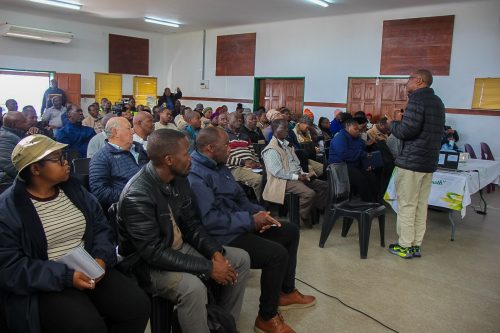


Some of the invited guests including Minister of Commerce, Industry and Trade Manqoba Khumalo, Lubombo RA Themba Msibi, UN Resident Coordinator George, and Ministry of Commerce US Phesheya Dube
BY PHESHEYA KUNENE – EDITOR
SIMUNYE — Regional sugar industry leaders have intensified calls for trade expansion, ethanol production, renewable energy investment and stronger climate resilience as Southern Africa’s sugar sector faces mounting global market pressure despite remaining one of the region’s most strategic economic drivers.
This emerged during the inaugural Standard Bank Regional Sugar Summit held at Simunye Country Club, where policymakers, financiers, millers, growers and technical experts from across Southern Africa gathered to discuss the future sustainability and competitiveness of the industry.
The summit focused on strengthening Africa’s sugar value chains, expanding regional trade corridors, improving productivity and accelerating diversification beyond traditional sugar production.
Eswatini Sugar Association Chief Executive Officer Banele Nyamane revealed that Eswatini’s sugar industry currently produces about 640 000 tonnes of sugar annually, generating approximately E7.7 billion in revenue. He said the sector contributes 6.3 percent to the country’s GDP, supports nearly 30 percent of the national workforce and accounts for about a quarter of export earnings.
Nyamane however warned that the industry was facing increasing pressure from low global sugar prices, rising production costs and surplus sugar stocks projected to reach nearly two million tonnes in the coming season.
He said the industry’s long-term recovery would depend on efficiency improvements, stronger regional trade integration, diversification and support for both commercial and smallholder growers.

Eswatini Sugar CEO Banele Nyamane revealed that the current sugar industry revenue is about E7.7 billion
Head of Advocacy and Stakeholder Engagement at Eswatini Sugar Nontobeko Mabuza highlighted the importance of regional collaboration and policy harmonisation in protecting export markets.
“Over 90 percent of the sugar produced in Eswatini is traded across borders, which highlights the importance of collaboration between industry and government in facilitating the movement of sugar into regional and global markets,” she said.
Mabuza said removing tariff barriers and improving trade policy consistency across the region would strengthen the sugar value chain and unlock new growth opportunities.
The summit’s first panel discussion focused on strengthening Africa’s value chain through unlocking capital and expanding trade corridors to global markets, while the second panel explored sustainable energy solutions for a climate-resilient and inclusive sugar industry.

EWADE CEO Dr Samson Sithole talked about the importance of water and climate smart irrigation systems
Discussions centred on biofuels, energy security, climate-smart agriculture, renewable energy integration, irrigation development, market diversification and infrastructure investment.
Royal Eswatini Sugar Corporation Managing Director Nick Jackson revealed that Simunye Mill is currently ranked the top sugar mill in Sub-Saharan Africa, while Mhlume Mill ranks second out of 29 mills assessed across the region.
Jackson said climate change was increasingly affecting cane quality, extraction efficiency and transport operations due to changing rainfall patterns.
He further revealed that RES Corporation was accelerating diversification into ethanol production, downstream packaging and large-scale power generation projects aimed at reducing reliance on sugar alone.
Jackson said the corporation was also working toward generating its own electricity and eventually reducing dependence on the Eswatini Electricity Company.
“We are currently the biggest client of EEC, but once we establish our own energy source, we intend to contribute about 50 percent of that power back into the national grid,” he said.
Ubombo Sugar Limited Managing Director Muzi Siyaya revealed that the company injected between E2 billion and E3 billion into the local economy during the past financial year through grower payments, procurement, transport and infrastructure development.

Standard Bank Eswatini CEO Mvuselelo Fakudze making his welcoming remarks
Siyaya said the future sustainability of the industry depended heavily on diversification, renewable energy and local empowerment.
He revealed that Ubombo Sugar was implementing a E1.5 billion investment aimed at increasing electricity generation capacity from 17 megawatts to 40 megawatts while also positioning itself for ethanol production.
Eswatini Water and Agricultural Development Enterprise (EWADE) Chief Executive Officer Dr Samson Sithole emphasised the importance of irrigation expansion, water security and climate-smart farming in strengthening regional competitiveness.
Sithole said regional cooperation and policy harmonisation remained critical for export-driven countries like Eswatini.
“When we work together as a region and differentiate ourselves through what we do well, we position ourselves strongly to remain competitive globally,” he said.
The Eswatini Cane Growers Association meanwhile raised concern over declining yields, which have fallen to around 90 tonnes per hectare due to rising input costs, climate shocks, pest pressure and governance challenges.
Industry financiers led by Standard Bank Eswatini also outlined expanded financing models targeting the sugar value chain, including invoice discounting, asset financing, unsecured lending and digital credit solutions aimed at improving production capacity and business sustainability.
Delivering remarks on behalf of Minister of Agriculture Mandla Tshawuka, Principal Secretary Sydney Simelane described Eswatini as one of Africa’s leading sugar producers relative to its size, highlighting the industry’s strong productivity, export standards and contribution to rural livelihoods.
Simelane said the sugar industry remained central to agricultural transformation across Southern Africa through outgrower schemes, smallholder integration, agro-processing, mechanisation and value addition initiatives such as ethanol, bio-energy and speciality sugar production.
He further noted that the industry continued to drive rural development through employment creation, infrastructure development, water and electricity expansion, transport services and community support systems around sugar-producing regions.
Simelane said the future of the industry depended on transforming the sector from a commodity producer into a broader regional catalyst for industrialisation, innovation, climate resilience and agribusiness development.
The summit concluded with renewed calls for stronger regional integration, investment in climate-resilient agriculture, improved logistics and deeper collaboration between governments, financial institutions and private sector stakeholders to secure the long-term sustainability of Southern Africa’s sugar industry.

Ubombo Sugar Limited MD Muzi Siyaya sharing a light moment with one of the guests