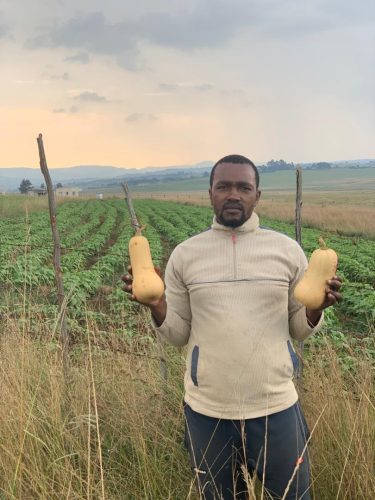

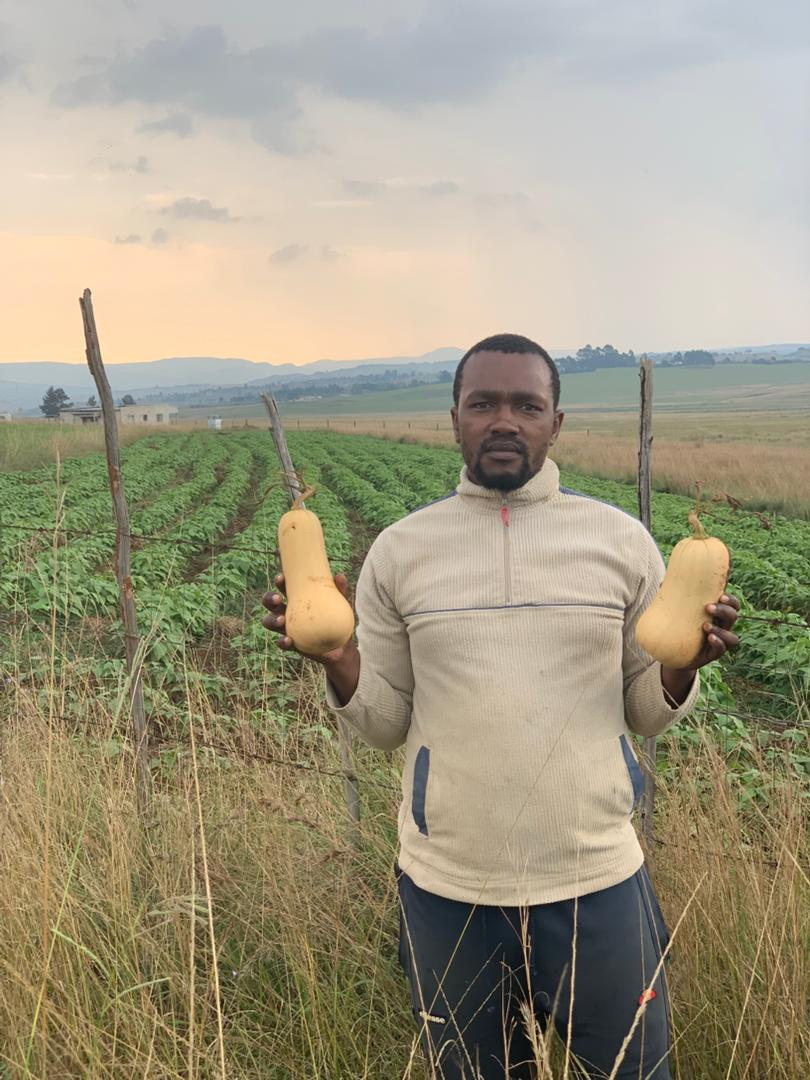
Sibusiso Welcome Mncina posing with a butternut harvested from his farm in Motjane
BY PHESHEYA KUNENE – EDITOR
MOTJANE – Eswatini remains heavily dependent on imported sugar beans, estimated at about 90 to 95 percent of the national supply, but in Motjane, a young farmer is building a structured production model aimed at narrowing that gap through commercial-scale discipline and coordinated smallholder production.
At the centre of this shift is Sibusiso Welcome Mncina (34), a mechanical engineering graduate turned agribusiness operator, currently harvesting sugar beans on two hectares alongside diversified vegetable production under a cooperative system involving 41 farmers.
His operation reflects a broader tension in Eswatini’s agricultural economy: rising demand for staples such as sugar beans versus limited local aggregation, inconsistent supply, and continued reliance on imports from South Africa, Malawi, and Tanzania.
COMMERCIAL FARMING APPROACH IN AN IMPORT-DEPENDENT MARKET
Mncina entered agriculture in 2020, initially operating at a small scale before transitioning into a coordinated production system supplying both informal markets and formal retail chains, including Freshmark, Pick n Pay, Spar, Indali Supermarket, and Easy Buy, as well as NAMBoard-linked channels.
“I was motivated by the import gap. If we are importing up to 95 percent of sugar beans, then locally there is a clear market that can be supplied,” he said.
His production strategy is built around structured planning, varietal selection, and risk balancing rather than subsistence output.
PRODUCTION STRATEGY: YIELD VERSUS RESILIENCE
On his two-hectare sugar bean plot, Mncina uses two commercial varieties, PAN 9216 and PAN 148, selected for complementary agronomic performance.
PAN 9216 delivers higher yields, estimated at 1.5 to 2 tonnes per hectare
PAN 148 provides stronger disease resistance, yielding around 1 to 1.5 tonnes per hectare
“The logic is balanced. PAN 9216 gives us output, PAN 148 gives us stability under disease pressure. You cannot rely on one variety alone,” he said.
Both varieties, however, present a shared operational constraint: delayed pod opening at maturity, increasing harvest timing sensitivity, and potential field losses if not managed precisely.
INTENSIVE AGRONOMY AND CONTROLLED PRODUCTION SYSTEM
Mncina’s production system reflects increasing mechanisation and technical discipline within smallholder agriculture.
Key practices include:
Herbicide-based weed control followed by delayed ploughing
Primary and secondary tillage for soil structure improvement
Lime application for soil acidity correction
Basal fertilisation using NPK 2:3:4 (40)
Top dressing with LAN (28) at the vegetative stage
Flowering-stage nutrient application for pod development
Planting is executed using a hand planter system at:
8–10 cm intra-row spacing
50 cm inter-row spacing
Planting depth of approximately 3 cm
“This spacing is deliberate. It reduces competition, improves airflow, and lowers disease pressure,” he said.
IRRIGATION AND CROPPING SYSTEM INTEGRATION
Sugar beans are produced under a rain-fed system, aligned with Highveld rainfall patterns, while vegetable production is supported through drip irrigation and fertigation systems.
Crop diversification includes:
Potatoes
Tomatoes
Green peppers
Spinach
Butternuts
Strawberries
This structure enables year-round cash flow and reduces dependence on a single commodity cycle.
“Beans are stable. Vegetables are high-risk but high-return. Together they balance the farm economy,” Mncina said.
Crop rotation is used to improve soil fertility, particularly by leveraging legumes to enhance nitrogen levels for subsequent crops.
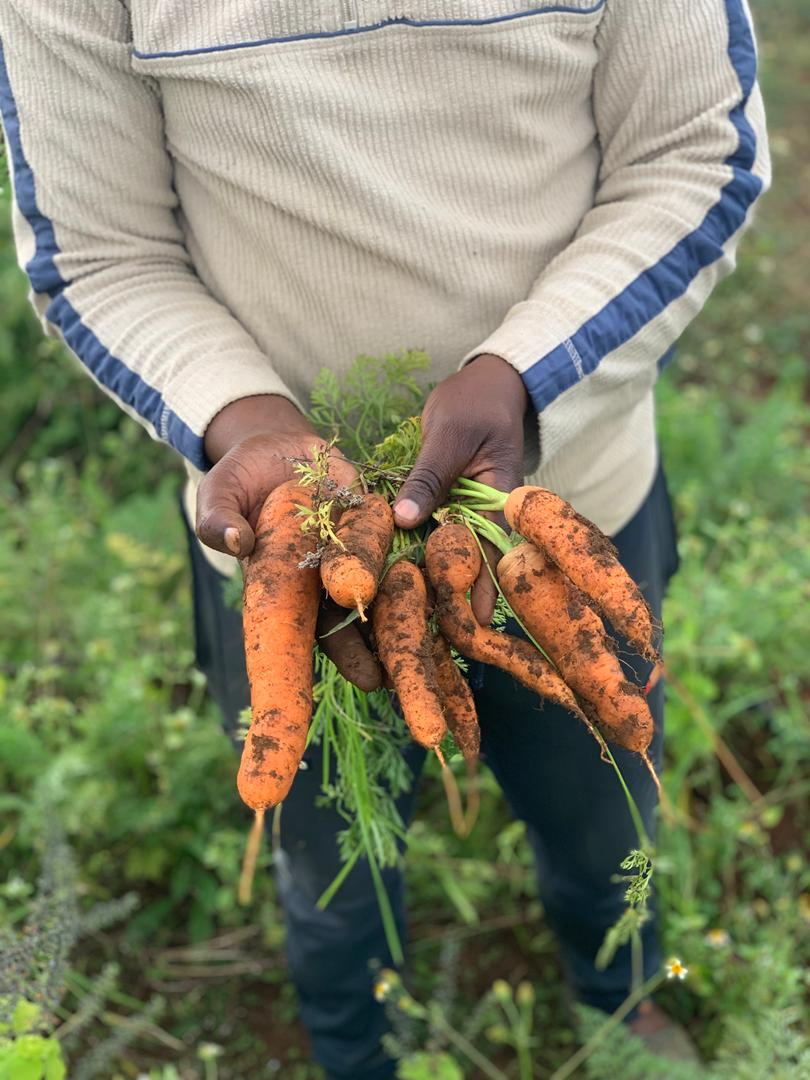
Sibusiso Mncina showing produce from his farm, including carrots
MARKET STRUCTURE AND PRICE REALITIES
Mncina sells through multiple channels, including supermarkets, NAMBoard-linked systems, and cooperative aggregation structures.
However, Eswatini’s sugar bean market remains fragmented, with:
Limited aggregation capacity
Weak grading and standardisation systems
High dependence on informal trading networks
Prices typically fluctuate sharply between harvest and off-season periods, a factor that reinforces import dependence during supply shortages.
IMPORT DEPENDENCE AND STRUCTURAL GAPS
Despite strong domestic demand, Eswatini continues to import sugar beans primarily from South Africa, Malawi, and Tanzania due to:
Inconsistent local supply volumes
Post-harvest handling inefficiencies
Weak coordination between farmers and buyers
Limited storage and processing infrastructure
Industry estimates indicate a persistent domestic production deficit exceeding 80–90 percent of national consumption, leaving the country structurally exposed to external supply chains.
COOPERATIVE MODEL AS A RESPONSE MECHANISM
Mncina’s cooperative model, involving 41 farmers, is designed to address aggregation inefficiencies by pooling production, standardising practices, and improving market access.
Through this structure, the group has accessed retail contracts and improved visibility within formal supply chains.
“When farmers work together, we can meet volumes and standards that individual farmers cannot achieve,” he said.
POLICY AND INSTITUTIONAL CONTEXT
The Ministry of Agriculture continues to provide extension support, while NAMBoard plays a role in marketing and aggregation.
However, structural constraints remain in aligning production with market demand.
Mncina argues that commercialisation requires stronger coordination between farmers, buyers, and institutions.
FOOD SECURITY AND ECONOMIC IMPLICATIONS
Sugar beans represent a critical protein source in Eswatini’s diet and a potential import substitution crop.
Increased local production could:
Reduce foreign exchange outflows
Strengthen rural incomes
Improve national food security resilience
Mncina’s model reflects an emerging class of commercially oriented farmers attempting to reposition Eswatini’s agricultural sector from fragmented subsistence production to structured market participation.
However, the gap between local production capacity and national demand remains significant.
The key constraint is no longer agronomic potential, but market structure, coordination and post-harvest systems.
“Farming must be treated as a business. Once that shift happens, everything changes,” Mncina said.
Sugar beans are increasingly emerging as a strategic crop in Eswatini’s agricultural transformation agenda.
But closing the import gap will depend on three structural shifts:
Commercial-scale coordination among farmers
Standardisation of quality and grading systems
Integration into formal retail and regional markets
Farmers like Sibusiso Mncina represent a growing shift toward disciplined, market-driven agriculture, positioning themselves within a sector that is still heavily import-dependent but structurally capable of transformation.