

NOSIPHO MKHIZE | JOURNALIST
MBABANE — Communities struggling to raise the 10 percent contribution required to access the Regional Development Fund (RDF) may now have a new route to bigger development projects, after officials confirmed that the Eswatini Environment Fund (EEF) grant can be used as that deposit in qualifying cases.
The clarification was made during an Eswatini Environment Fund webinar held on 30 March 2026, where applicants were taken through funding categories, eligibility requirements and the application process for the current call.
Sisekelo Shongwe, Project Officer at the Eswatini Environment Fund, told participants that the grant of up to E300,000 can be used as the required RDF contribution, provided the timelines between the two funding processes are aligned.
“Yes, correct. You can. You can definitely use the Environment Fund grant as a 10% deposit,” said Shongwe, while cautioning applicants to ensure that the timing of their RDF project matches the Environment Fund implementation period.
The announcement is likely to draw attention from communities that have long viewed the RDF contribution requirement as a major barrier to accessing larger government-backed projects. Under RDF requirements, communities are expected to contribute at least 10 percent of total project cost, while the fund may finance up to 90 percent.
For many groups, that upfront contribution has been one of the main reasons promising projects fail to move beyond proposal stage.
The EEF clarification now positions the fund as more than a grant for environmental protection alone. It also opens the possibility for communities to use environmental projects as a stepping stone towards bigger infrastructure and livelihood initiatives.
This means community groups with projects linked to water harvesting, wetland restoration, tree planting, recycling, biodiversity conservation, greenhouse farming or nursery development may not only access environmental funding, but could also use it to strengthen their chances of unlocking broader community development finance.
Officials said the Environment Fund is open to a wide range of applicants, making it one of the more accessible public grant opportunities available to grassroots groups.
Eligible applicants include community-based environmental groups, youth groups, non-governmental organisations, civil society organisations, individual applicants whose projects benefit the wider community, as well as schools, colleges, universities and research institutions.
Shongwe said individuals are allowed to apply, but stressed that projects must demonstrate benefits beyond one person.
“As long as your project is a project that benefits others as well, it should not be a project that is only for you,” she said.
She added that the fund is designed to reach even those at grassroots level, with forms available in both English and siSwati, and submissions accepted either electronically or physically.
To qualify, projects must show a positive environmental impact, demonstrate how they will improve community livelihoods, and prove they can continue beyond the funding period. Applicants are also expected to show community ownership or stakeholder involvement, while proposals that include youth, women and people with disabilities are encouraged.
One of the key messages from the webinar was that environmental protection should not be treated as separate from everyday economic survival.
Shongwe said applicants should think beyond conservation alone and show how their ideas can also support income generation and strengthen livelihoods.
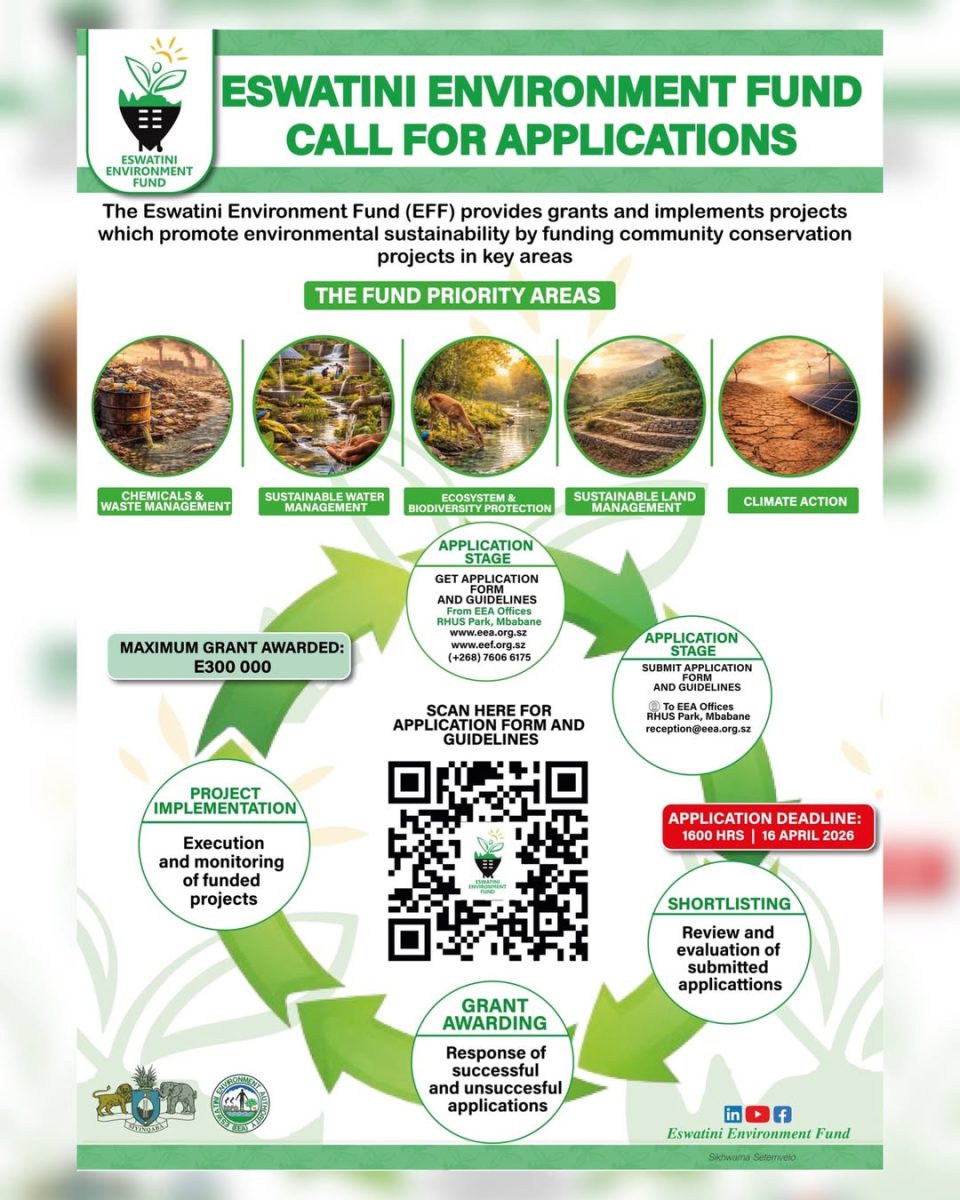
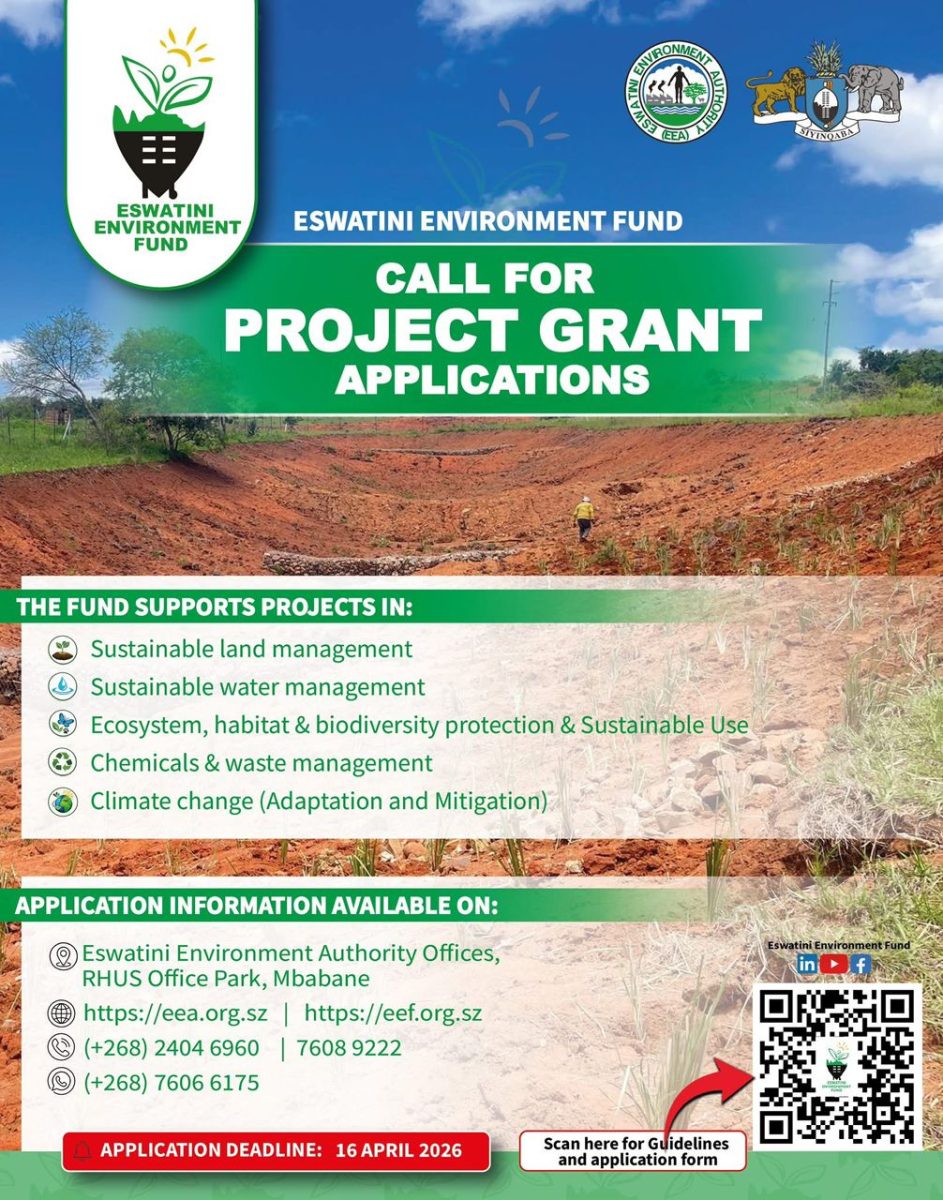
Priority funding areas under the current Environment Fund cycle are sustainable land management, sustainable water management, chemicals and waste management, climate change adaptation and mitigation, and ecosystem and biodiversity protection and sustainable use.
Officials explained that these areas can cover projects such as land rehabilitation, tree planting, wetland protection, water harvesting, dam-related interventions, recycling, safer chemical handling, greenhouse production, ecotourism initiatives and environmental education projects.
The application process begins with obtaining the official form, which is available from the Eswatini Environment Authority website, the Environment Fund office, or by request through official contact channels, including WhatsApp.
Applicants may type and email the form or complete it by hand and submit it physically.
Among the compulsory requirements is a letter from the relevant local authority approving the project. For applicants in urban areas, officials said letters from municipalities are also accepted. Additional support documents, including letters from funders or technical partners, may be attached where relevant.
Once the submission deadline closes, applications go through a desktop evaluation by a Technical Selection Committee made up of specialists from different fields, including environmental experts, engineers, researchers and gender and youth specialists.
Projects that score above the cut-off mark move to the second stage, which involves either ground-truthing visits or project presentations.
Officials said applicants with concept-stage projects that do not yet have a physical site will still be considered and may present their ideas directly to the panel.
Final decisions are made by the Board of Trustees, after which successful applicants are announced and feedback is given to all applicants.
For communities with plans that have stalled because they could not raise the RDF contribution, the latest clarification is likely to be seen as a significant opening.
Instead of viewing the Environment Fund only as a conservation facility, communities may now begin to see it as a practical route into larger development projects — particularly those that combine environmental protection with jobs, income and local economic growth.