

BY PHESHEYA KUNENE
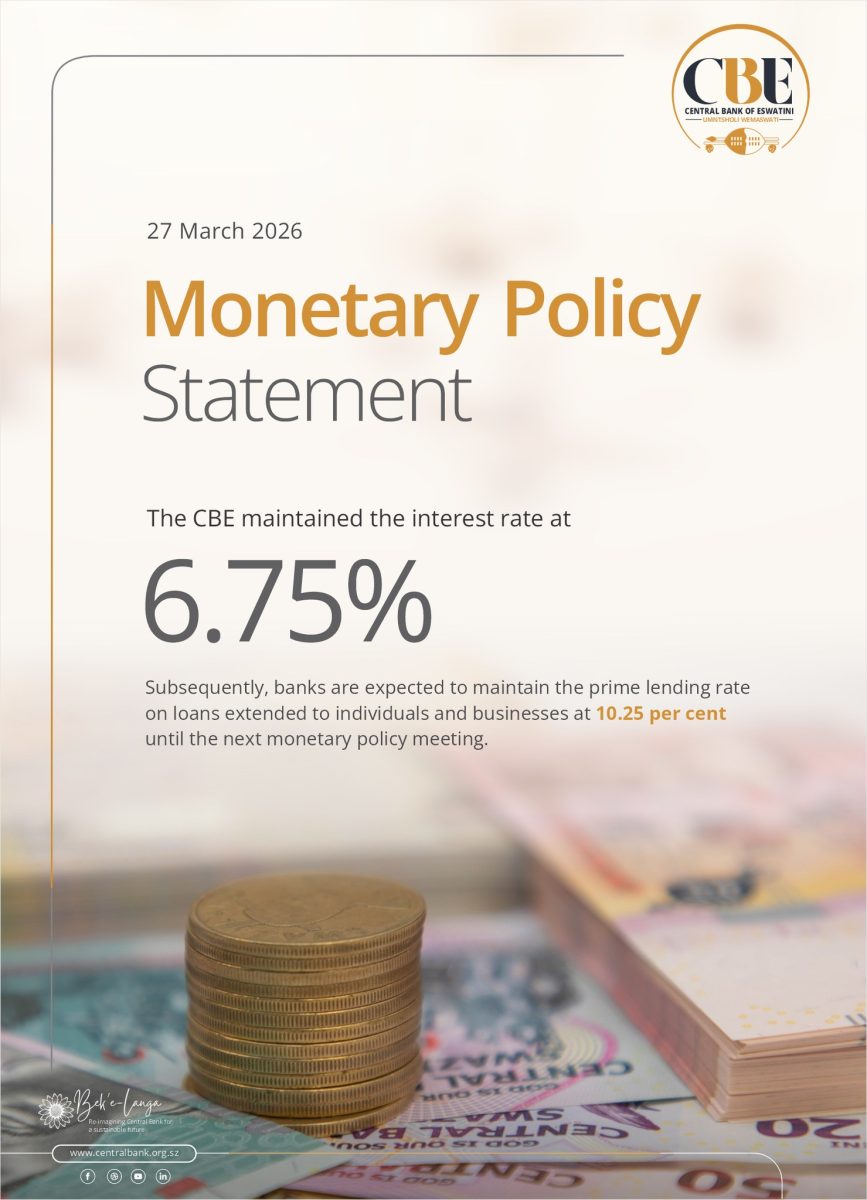
EZULWINI – The Central Bank of Eswatini’s decision to keep the discount rate unchanged at 6.75 per cent may have reassured markets, but for agriculture the message is more mixed: inflation is easing, yet affordable credit remains out of reach for many farmers.
Presenting the Monetary Policy Statement on Friday, 27 March 2026, Governor Phil Mnisi said the Bank had opted for caution as global risks remain elevated. Headline inflation slowed to 1.9 per cent in February 2026 from 2.1 per cent in January, while the annual inflation forecast was revised downward to 3.33 per cent.
Mnisi said a “cautious approach towards policy decisions remains critical”, citing persistent global uncertainty and upside inflation risks.
The decision keeps Eswatini aligned with South Africa, which also left its repo rate unchanged at 6.75 per cent. With the lilangeni pegged to the rand, major policy divergence would risk currency instability, imported inflation and capital outflows. In that sense, the Bank’s room to manoeuvre remains limited.
At home, however, the economic picture is more encouraging. GDP grew by 5.8 per cent year-on-year in the third quarter of 2025, up from 4.3 per cent in the previous quarter, with overall growth projected at 3.9 per cent for 2025 and 4.2 per cent in 2026. Inflation has also eased from an average of around 4 per cent in 2024, helped by lower electricity tariffs and softer supply-side pressures.
Even so, the Bank stopped short of cutting rates.
That means commercial banks are expected to keep the prime lending rate around 10.25 per cent, leaving borrowing costs high for businesses and households. While the stance supports price stability, it offers little direct stimulus to productive sectors such as agriculture.
For farmers, the implications are significant.
Lower inflation should ease pressure on input costs, especially fuel and imported fertilisers, giving producers some predictability in planning. But the cost of credit remains a major obstacle, particularly for smallholders who need financing for irrigation, mechanisation and expansion. At current lending levels, many such investments remain difficult or unviable.
Private sector credit grew by 5.3 per cent year-on-year in January 2026, but fell on a monthly basis, suggesting tighter lending conditions. That matters for agriculture because weaker access to finance slows productivity, limits output growth and ultimately affects food prices, rural incomes and food security.
Economist Welcome Nxumalo said the decision supports macroeconomic stability but does little to resolve agriculture’s financing constraints.
He said the rate hold “anchors macroeconomic stability, but it does little to ease the structural financing challenges facing agriculture,” adding that without targeted credit interventions, smallholder farmers would remain excluded from meaningful growth opportunities. He argued that the main challenge is no longer inflation, but access to affordable capital.
Another economist, Sanele Sibiya, said the Central Bank had struck a necessary balance between stability and risk management, warning that an early rate cut could expose Eswatini to external shocks linked to geopolitical tensions and volatile commodity markets. But he also noted that monetary policy alone cannot transform agriculture, calling for fiscal support, subsidised lending and targeted agribusiness support.
From the farming community, the response was more direct. ESNAU Chief Executive Officer Tammy Dlamini said the decision provides stability, but not relief.
He said easing inflation, particularly on inputs, was welcome, but unchanged borrowing costs continued to weigh on farmers’ ability to invest and grow. For smallholders especially, he said, expensive credit remains a barrier to scaling production, adopting modern farming methods and recovering from seasonal shocks.
Dlamini warned that the current environment risks widening inequality in the sector, as larger commercial farmers remain more able to access finance while emerging farmers are locked out.
“Farmers are not just price-takers, they are also borrowers,” he said. “If credit remains expensive, then growth in agriculture will remain slow, and that has direct implications for food security and rural livelihoods.”
Risks remain.
The Central Bank has already warned that global supply chain disruptions, geopolitical tensions and climate variability could still threaten price stability and agricultural output. At the same time, public debt stood at E38.8 billion, or 40.4 per cent of GDP, in February 2026, while gross reserves covered only 2.6 months of imports, leaving the economy exposed to external shocks.
For now, the Bank’s position is clear: stability first.
But for agriculture, stability alone is not enough. Farmers and agribusinesses need affordable credit, stronger infrastructure and better market access if growth is to reach the productive sectors that matter most. Monetary policy can create a stable environment, but it cannot on its own unlock agricultural transformation.
As 2026 unfolds, the real question is not whether inflation will stay under control. It is whether Eswatini’s broader policy environment can turn stability into growth for farmers on the ground.