

BY PHESHEYA KUNENE – EDITOR
MBABANE – The Joint River Basin Authorities Project Board (JRBA-PB) yesterday bade a poignant farewell to its founding Chief Executive Officer, Ms. Sindy Mthimkhulu, who has steered the institution for over a decade, shaping it into a cornerstone of Eswatini’s water governance and agricultural sustainability.
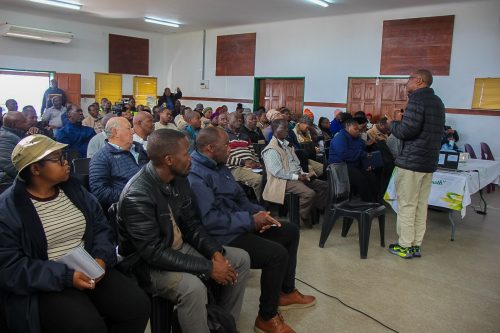
Speaking at the farewell event, Mthimkhulu reflected on the odyssey of transforming the vision of the Water Act into a tangible, stakeholder-driven institution.
“They say that a river’s journey begins with a single drop, but for the Joint River Basin Authorities Project Board, it began with a mandate. After more than ten years in government striving to operationalise the Water Act, I had to explore all possibilities of making decentralisation work in practice,” she said.
Her decade-long tenure was anchored in the lessons gleaned from her early years at the Department of Water Affairs, equipping her to navigate the intricate challenges of establishing an institution dedicated to integrated water management.
“When I accepted the role of Founding CEO, my mission was to breathe life into Section 79 of the Water Act. Today, looking back, we didn’t merely build an office; we built an institution. We transitioned from the abstract concept of ‘Integrated Water Resources Management’ to the practical, daily stewardship of Eswatini’s most vital resource. We demonstrated that water governance is not about control—it is about coordination, collaboration, and sustainability,” Mthimkhulu added.
Under her leadership, the JRBA‑PB achieved transformative milestones that have had direct ramifications for Eswatini’s agricultural sector:
Regulatory Frameworks for Sustainable Use: The Board introduced Water Pricing Regulations, Dam Safety Guidelines, and Water Permitting Guidelines, creating a foundation for equitable water access. These frameworks are critical for irrigation‑dependent farmers who rely on timely and predictable water allocation to safeguard crop yields.
International Collaboration: The Blue Deal Partnership with Dutch Water Authorities provided technical expertise and fostered a cultural shift in basin‑level operations, enhancing operational efficiency for agricultural water users.
Regional and Global Influence: By hosting the 7th International REMCO Conference and actively participating in transboundary commissions, Eswatini positioned itself as a leader in shared water management, ensuring agricultural and industrial sectors are represented in key cross‑border water allocation decisions.
Infrastructure and Digital Transformation: Operationalising five River Basin Authorities and implementing sophisticated digital monitoring systems has equipped water managers—and by extension, farmers—with better data to inform irrigation scheduling and manage climate‑related risks.
Next Chapter: Leadership at INMACOM
As she stepped down from JRBA‑PB, Ms. Mthimkhulu assumed a new mandate as Executive Secretary of the Incomati and Maputo Watercourse Commission (INMACOM), effective August 1, 2025. Her appointment to the transboundary institution underscored both her expertise and Eswatini’s growing influence in regional water governance.
INMACOM is a transboundary river basin organisation established in 2021 to oversee cooperation among Eswatini, South Africa, and Mozambique in the management of the Incomati and Maputo Basins, shared watercourses vital for agriculture, energy and livelihoods across the region.
The Commission promotes sustainable and equitable allocation of shared water resources, supports integrated water resources management, facilitates knowledge sharing for informed planning, and fosters capacity building for stakeholders, including basin communities and agricultural water users.
In her new role, Mthimkhulu will lead efforts to enhance transboundary cooperation that directly impacts farmers and rural economies dependent on basin water flows—ensuring drought resilience, equitable irrigation access, and harmonised regional water strategies.
Looking toward the future, Mthimkhulu expressed confidence that JRBA‑PB will continue to play a pivotal role in Eswatini’s agricultural resilience. She envisions a data‑driven institution capable of predicting droughts, mitigating floods, and ensuring that farmers, agro‑processors, and rural communities remain water‑secure in an era of climate volatility.
“To the team I built, you have been my greatest support. You embraced the uncertainty of the early days with professional rigor and personal courage. A river is defined by its banks, but its power comes from its flow. You were the banks, the structure, the law, and the discipline. Keep the water flowing with integrity,” she said.
Mthimkhulu leaves behind a strengthened institution, ready to support sustainable agricultural practices, foster climate resilience, and serve as a benchmark for river basin management across the SADC region.
For Eswatini’s farmers and the nation’s broader agribusiness sector, the JRBA‑PB’s evolution under her leadership has been nothing short of transformational.