

BY: PHESHEYA KUNENE | EDITOR
MANZINI – Farmers must stop seeing themselves as mere producers and start acting as leaders, innovators and decision-makers if Eswatini is to secure its agricultural future.
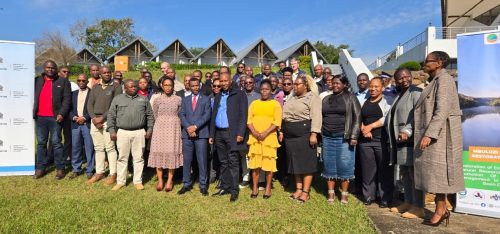
That was the strong message from Eswatini Water and Agricultural Development Enterprise (EWADE) Chief Executive Officer Dr Samson Sithole, who used the launch of the organisation’s Digital Transformation Strategy in February 2026 to challenge farmers and agricultural stakeholders to embrace a new style of leadership built on agility, collaboration and smart decision-making. The strategy was launched on Tuesday, February 24, 2026, at Happy Valley Hotel, where EWADE positioned 2026 as its “Year of Intelligent Transformation.”
Speaking during the launch, Sithole urged EWADE staff, farmers, young people and agricultural professionals to rethink what leadership means in modern agriculture.
“Empowered teams are the foundation of meaningful transformation. When people are trusted to act, innovate and collaborate around a shared vision, organisations move further and faster together,” Sithole said.
“Leadership today is not about control, it is about connection, trust and enabling others to lead.”
His remarks linked directly to EWADE’s new digital transformation push, which the organisation says is aimed at making its work more intelligent, agile and connected through integrated systems, real-time data, faster decision-making and stronger coordination across departments and project sites. EWADE says the strategy is meant to improve operational efficiency, resource allocation, oversight and service delivery.
For Eswatini, the message lands at a critical time. Agriculture remains central to rural livelihoods and national food systems, but the sector continues to battle climate shocks, low productivity, weak commercialisation and heavy dependence on rain-fed farming. World Bank data shows agriculture accounted for about 6.8 percent of Eswatini’s GDP in 2023, while IFAD says the sector contributes about 8 percent of GDP and employs 13 percent of the labour force, underlining both its importance and its unrealised potential.
Against that backdrop, Sithole’s message was not just about internal corporate culture. It was also a wider call for a smarter, more responsive agricultural sector in which farmers are able to think commercially, respond quickly to changing conditions and work in step with a broader national vision.
To explain that philosophy, Sithole turned to an unlikely metaphor: the octopus.
According to EWADE’s presentation of the strategy, the octopus symbolises a system in which one central intelligence guides multiple semi-independent arms. Each arm is capable of acting on its own, but all remain aligned to the same purpose. Sithole said that is the model Eswatini’s agriculture sector should adopt.
“Think of it like a CEO delegating tasks to a team of managers,” he explained.
“The central brain sets the vision, but each arm acts independently to achieve the goal.”
In practical terms, this means farmers, extension officers, technicians, managers and agribusiness partners must all be empowered to act, solve problems and innovate, while remaining connected to one larger mission: building a productive, resilient and commercially driven agricultural sector.
“This is our moment to evolve, to become agile, more connected and more intelligent in everything we do,” Sithole said.
“Like the octopus, we must adapt with precision, collaborate with purpose and innovate with confidence.”
That thinking also fits squarely into EWADE’s wider transformation agenda. The enterprise says its digital strategy is more than a technology plan; it is a strategic shift in how it will operate, collaborate and deliver impact across water and agricultural development programmes. It places particular emphasis on unified data, evidence-based decision-making, agile workflows and reduced institutional silos.
For farmers, that matters because digital transformation is increasingly becoming part of agricultural transformation. Smarter systems can improve project planning, strengthen extension support, track results more effectively and help institutions respond faster to the realities faced by farmers on the ground.
EWADE’s broader development work already shows the scale of what is at stake. The institution remains one of the country’s most significant agricultural development agencies, driving irrigation expansion, rural infrastructure and farmer support programmes aimed at shifting communities from subsistence farming into commercial production. Its core mandate is to transform the water and agriculture sectors by empowering people in commercial agriculture through innovative technologies, integrated agro-value chains and partnerships.
That transformation is most visible in irrigation-led development. EWADE continues to anchor some of the country’s most ambitious rural agricultural investments, including the Mkhondvo-Ngwavuma Water Augmentation Programme, which is expected to expand irrigation, raise output and stimulate rural economic activity in southern Eswatini. Such investments are increasingly seen as essential in a country where climate variability continues to disrupt yields and expose the vulnerability of rain-fed farming.
Sithole’s message, however, was clear: infrastructure alone will not be enough.
Dams, canals, irrigation schemes and financing can create opportunity, but transformation will stall if the people meant to drive it remain passive. Farmers must begin to see themselves not only as growers, but as agripreneurs, problem-solvers and leaders within value chains.
That is where the octopus metaphor becomes powerful. In Sithole’s view, the future belongs to agricultural systems that are coordinated but not rigid, strategic but not slow, and empowered at every level.
“Like the octopus, our strength lies in coordination and intelligence across the entire system,” he said.
As Eswatini pushes ahead with digital modernisation and agricultural investment, Sithole’s remarks serve as both a challenge and a warning.
The tools for transformation are gradually falling into place. The infrastructure is expanding. The strategy has been launched. The digital shift has begun.
Now, the real question is whether farmers and agricultural institutions will lead boldly enough to match the moment.
If they do, Eswatini’s agricultural sector could become one of the country’s strongest engines of growth, resilience and job creation.
If they do not, the opportunity may remain just beyond reach.