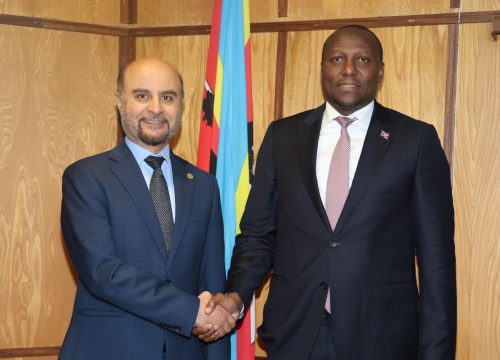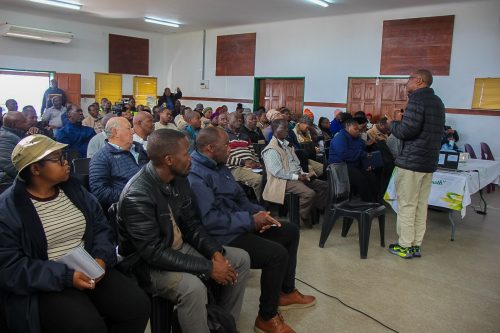


Prime Minister Russell Mmiso Dlamini addressing the media about electricity tariffs at the Cabinet Conference Room.
BY: SIBUSISO MNGADI | EDITOR IN CHIEF
MBABANE — Government has moved to calm public anger over the new electricity tariff increase, with Prime Minister Russell Mmiso Dlamini announcing a special E200 million relief package to cushion households and businesses from the impact of the 13.61 percent power hike.
In a statement delivered on Wednesday, the Prime Minister said Cabinet had intervened after weighing public concerns and the pressure the increase would place on ordinary emaSwati, businesses and the wider economy. Government, he said, wants to soften the blow without destabilising the Eswatini Electricity Company.
That relief will come in the form of E100 million in 2026 and another E100 million in 2027, to be channelled through the Eswatini Energy Regulatory Authority, which will work with EEC to determine how the funding can best reduce the burden on the public and help prevent future sharp increases.
For farmers, this announcement is more than just an energy story. It is a food production story.
Across Eswatini, electricity powers irrigation pumps, dairy cooling systems, poultry houses, packhouses, cold rooms and agro-processing operations. When tariffs go up, production costs rise with them. That hits commercial farmers, smallholders and agri-businesses alike. In practical terms, it can mean more expensive irrigation, higher storage costs and tighter margins for producers already battling costly inputs, transport pressures and erratic weather.
For the general population, the fear is equally real. Once electricity goes up, the pain rarely ends at the power meter. It often spills into the prices of food, goods and services as businesses try to recover rising operating costs. That is why the Prime Minister’s intervention will be watched closely by both consumers and producers. The implication is clear: if energy costs are not controlled, the cost of living rises further.
The Prime Minister was frank about the roots of the problem. He said the country is now paying for historical decisions to rely heavily on imported electricity instead of expanding local generation sooner. In one of the strongest admissions in the statement, Government said the chance to avoid the current pain had been missed many years ago.
Now, Government says it wants to change course fast.
Dlamini said Eswatini would aggressively pursue energy self-sufficiency by 2030, a move aimed at giving the country greater control over pricing and supply stability. He said projects already under way are expected to deliver 188.6 megawatts by 2030, including a 75MW solar project, 40MW from Illovo biomass, 13.6MW from the Lower Maguduza Hydro Project, 10MW from the Maguga hydropower expansion and 50MW from the RES Corporation project.
Government is also considering licences for an additional 1,400MW, saying this would put Eswatini on a stronger path to cutting import dependence and building the power base needed for industrialisation. EEC has also been told to speed up internal reforms aimed at long-term sustainability and energy self-sufficiency.

For agriculture, that long-term plan could be decisive.
Reliable and affordable electricity is no longer a luxury on the farm. It is central to modern production. It determines whether irrigation systems run efficiently, whether milk stays cold, whether fresh produce reaches the market in good condition and whether value-addition businesses can grow. A country that secures cheaper, more stable power gives its farmers a better chance to produce competitively and protect food security.
The immediate question now is how much relief consumers and producers will actually feel, and how quickly.
What is clear already is that Government has recognised the tariff increase as a national economic issue, not just a technical energy adjustment. For farmers, households and businesses, the stakes are the same: if electricity becomes too expensive, everything else starts costing more too.