
BY NOSIPHO MKHIZE | JOURNALIST
Luyengo — The University of Eswatini has launched a demonstration site for coffee and turmeric aimed at showing how crop production can be built around ecological relationships, local learning and climate resilience rather than high-input farming systems.
The site, established at UNESWA, positions agroecology not as theory discussed in lecture rooms, but as a practical field-based model where crops are grown in ways that respond to shade, soil health, moisture, biodiversity and changing climatic conditions.
At the centre of the initiative are coffee and turmeric, two crops the university and its partners believe can help illustrate how farmers can design production systems that work with nature while also improving quality and market value.
Project stakeholders say the site is intended to serve as a live learning space where farmers, researchers and development partners can observe how crops perform within diversified farming systems under local conditions.
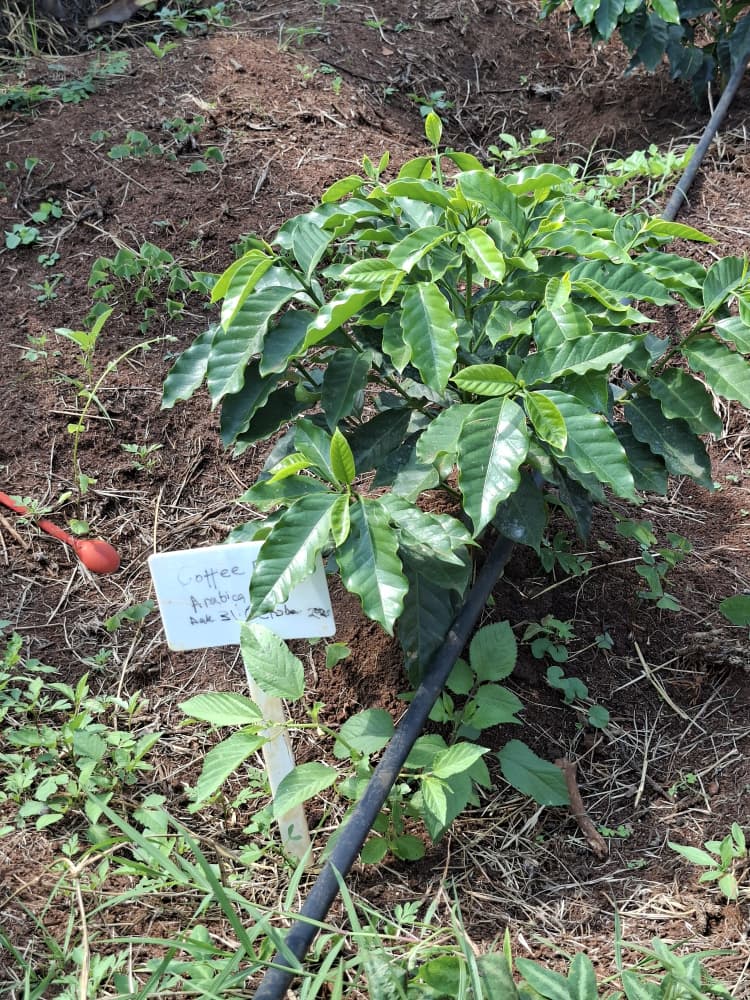
Coffee plant showed at the demonstration site.
One of the key messages emerging from the coffee component is that the crop performs best when treated as part of a wider ecological system, rather than as a standalone commodity. According to Victor Shongwe, Horticulture Lecturer at Luyengo University of Eswatini, coffee is “naturally adapted to shade,” a principle now being tested at the demonstration site through different growing arrangements.
Some coffee plants are being grown under macadamia trees, while others are benefiting from banana shade, allowing researchers and farmers to assess how different shade conditions influence plant performance, resilience and bean quality.
That makes the project significant beyond crop husbandry alone. It opens up questions about quality differentiation, value addition and how ecological design could influence the characteristics of the final product.
Another finding being explored through the site is that “shade changes quality,” suggesting that the production environment may shape not only yield and plant health, but also commercial attributes linked to the coffee itself.
For UNESWA, the launch signals a shift toward research and demonstration models that are more closely aligned with the realities facing farmers, especially under climate pressure. Rather than promoting simplified production systems that rely heavily on external inputs, the site is examining how layered and diversified systems can strengthen resilience while improving the use of land, water and soil resources.
Turmeric adds another dimension to that model.
Unlike coffee, which highlights above-ground relationships such as shade and companion planting, turmeric demonstrates the importance of soil-centred agroecological practices. The crop is well suited to warm, humid environments and performs best in fertile, well-drained soils with high organic matter. It also responds well to mulching, partial shade and stable moisture conditions, making it a strong fit for mixed farming systems.
Its inclusion at the site reinforces the case for diversification. In a layered agroecological system, trees and taller crops can create moderated microclimates, while lower-layer crops such as turmeric make productive use of space closer to the ground. This kind of integration can help farmers spread risk, improve soil cover, reduce moisture loss and build more stable production systems.
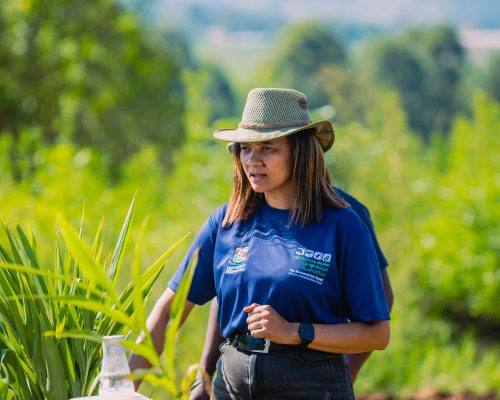
Turmeric farmer Sibongile Macwele said the practical lessons emerging from the demonstration site point to a model that links sustainability directly with income generation.
“The key takeaway is that adopting permaculture practices offers significant benefits for farmers by enhancing both sustainability and profitability. For example, coffee grown under shade requires less water, thrives more effectively, and ultimately produces a superior taste compared to coffee cultivated in full sun without protection,” she said.
She added that improved quality can strengthen market value and help farmers secure better prices, making ecological production not only environmentally sound but commercially attractive.
That argument is likely to resonate strongly in Eswatini, where climate variability, soil degradation and rising production costs continue to put pressure on conventional farming systems. By focusing on crops that thrive through ecological balance rather than isolation, the UNESWA site is also contributing to a broader conversation about what climate-smart and market-oriented agriculture could look like in practice.
The site’s research dimension, supported through university collaboration and engagement with Coffee Depot, is expected to generate evidence that can be used both in academic work and in farmer training. That gives the initiative added relevance, positioning it as both a knowledge platform and a practical demonstration for the farming sector.
Ultimately, the launch of the demonstration site is about more than introducing coffee and turmeric plots. It is about testing whether agriculture in Eswatini can become more productive, profitable and resilient by being designed around natural systems.
At UNESWA, that question is now being answered in the field.