

BY: PHESHEYA KUNENE | EDITOR
EZULWINI – Irrigation systems will be a determining factor in the success of Eswatini’s E740 million cassava production project, as stakeholders move to transition small-scale farmers from rain-fed agriculture to commercially viable, export-oriented production.
The initiative, led by the Eswatini Cassava Agri-industrial Center, is targeting smallholder farmers across Swazi Nation Land, but stakeholders say production must shift from rain-fed practices to structured irrigation systems to unlock the crop’s full potential.
Co-founder Isaac Knafo said while cassava is drought-tolerant, relying on rainfall alone limits productivity. He stated that consistent irrigation is essential during the early growth stages to ensure strong root development and higher yields.
“Cassava can survive without much rain, but if you want big roots, uniform quality and real money, you must irrigate,” he said.
WHY IRRIGATION MATTERS IN ESWATINI
Eswatini’s rainfall patterns are increasingly erratic, with dry spells affecting crop performance, particularly in regions such as the Lowveld. For a crop intended for industrial processing into flour, starch and ethanol, consistency in size, moisture content and yield is non-negotiable.
Anish Sivadas said international markets, particularly India, demand reliable volumes and quality.
“You cannot supply global markets with rain-fed uncertainty. Irrigation brings control, and control brings contracts,” he said.
BEST IRRIGATION SYSTEMS FOR CASSAVA FARMERS
Agricultural experts at the workshop outlined three main irrigation systems suitable for Eswatini:
Drip Irrigation (Recommended):
The most efficient system, delivering water directly to plant roots with over 90% efficiency. It reduces water loss, prevents waterlogging and improves tuber size. Ideal for small-scale farmers due to its scalability and water-saving benefits.
Sprinkler Systems:
Suitable for larger fields, mimicking rainfall but less efficient than drip. Works well where water availability is moderate.
Furrow Irrigation:
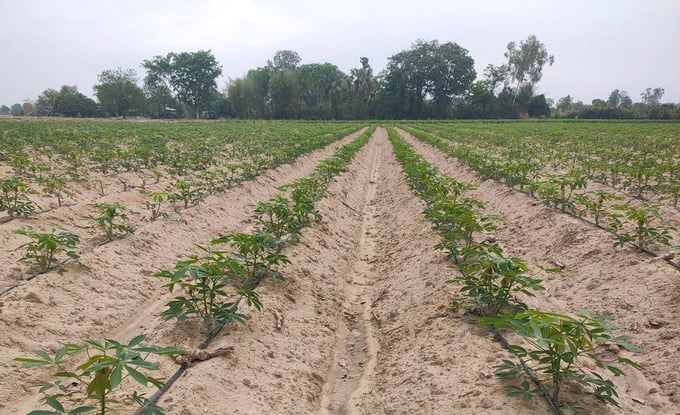
A traditional method using channels between crop rows. While cheaper, it is water-intensive and less precise, making it less suitable for commercial cassava production.

HOW TO SET UP A BASIC DRIP SYSTEM
A standard drip irrigation system follows a simple structure:
water source → filter → pressure regulator → main pipe → lateral pipes → emitters → plant roots
Farmers require a reliable water source such as a borehole or storage tank, a filtration system to prevent clogging, and a network of pipes delivering water directly to each plant. Emitters typically release 2–4 litres per hour, ensuring controlled moisture levels.
KEY IRRIGATION PRACTICES FOR CASSAVA
Irrigate consistently during the first 3–4 months after planting to support root establishment
Maintain moderate soil moisture, avoid waterlogging which damages tubers
Water every 2–3 days in dry conditions, depending on soil type
Use mulching to conserve moisture and reduce evaporation
Combine irrigation with fertiliser application (fertigation) to improve nutrient uptake
Mlamuli Nkambule from Luyengo said irrigation could transform smallholder production.
“We have been relying on rain, but yields are not consistent. With irrigation, we can produce more and meet market demand,” he said.
LINKING IRRIGATION TO PROFITS
Under the cassava project, one hectare has the potential to generate up to E500 000, but this depends on achieving high yields and consistent quality. Irrigation directly influences both.
Cassava used for industrial processing requires uniform root size and high starch content, both of which are improved under controlled watering systems. Without irrigation, farmers risk producing low-grade crops unsuitable for export or processing.
BEYOND WATER: INTEGRATED FARM MANAGEMENT
Experts emphasised that irrigation must be combined with:
Soil testing to determine nutrient requirements
Proper fertiliser use for balanced plant growth
Crop rotation with legumes to maintain soil health
Use of improved planting material for higher yields
This integrated approach is central to the agro-industrial hub model, where farmers are linked to processing facilities such as the starch plant in Siphofaneni.
A SHIFT FROM SUBSISTENCE TO COMMERCIAL FARMING
The cassava project represents a structural shift in Eswatini’s agriculture, moving farmers from rain-dependent subsistence production to market-driven commercial farming.
With export markets already identified and demand from India increasing, irrigation infrastructure will determine whether small-scale farmers can participate meaningfully in the value chain.
Knafo said the message to farmers is clear: “If you want to be part of this project and make money, you must farm professionally. Irrigation is not an option, it is a requirement.”
As the E740 million project moves towards implementation, investment in irrigation systems is expected to be a defining factor in its success, shaping not only yields, but the future of cassava farming in Eswatini.