

BY PHESHEYA KUNENE
EZULWINI – Eswatini has launched a US$40 million (about E740 million) cassava commercialisation project aimed at bringing smallholder farmers into export-oriented value chains, as the country intensifies efforts to diversify beyond sugar and build a more resilient agricultural economy.
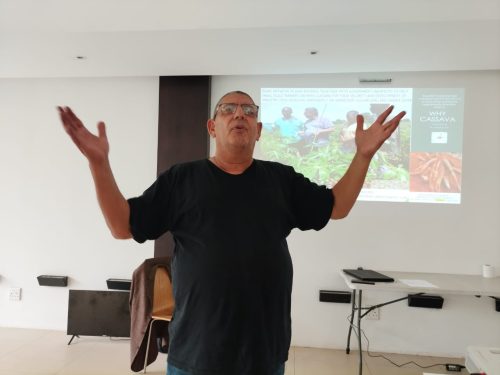
The initiative, led by the Eswatini Cassava Agri-industrial Centre in partnership with TRIOMF Eswatini, was presented to farmers and stakeholders on Tuesday, 7 April 2026, as a strategic intervention to position cassava as a high-potential crop for food security, agro-processing and export growth.
The project comes at a time when the global cassava market exceeds 330 million tonnes annually, with Africa producing more than 60 percent of total output but capturing only a limited share of high-value export markets. That gap, largely driven by weak processing capacity and fragmented value chains, is what the Eswatini initiative aims to close.
Co-founder Isaac Knafo said the project is built around an agro-industrial hub model designed to connect farmers not only to production, but also to processing infrastructure and international buyers. He said cassava presents a faster, more climate-resilient return profile than many traditional crops.
“We are building a system where farmers do not just produce, but participate in processing and market access,” said Knafo, adding that the project already has a functioning starch and flour processing facility in Siphofaneni.
The first phase of the project will cover 800 hectares over two years, with plans for nationwide expansion as more chiefdoms are incorporated. Participating farmers are expected to receive inputs, technical support and access to financing, with aggregation playing a central role in meeting export-scale demand.

From a regional trade perspective, cassava remains underdeveloped in Southern Africa despite growing demand. South Africa, for instance, exported more than US$10 million worth of cassava in 2022 to markets in Europe and the Middle East, while also importing cassava from neighbouring countries. Analysts say this points to a clear opportunity for Eswatini to position itself as a competitive supplier within SADC and beyond.
TRIOMF Eswatini representative Kenneth Dlamini said commercial success would depend heavily on strong agronomic practices, especially soil testing and proper fertiliser management.
“Yield is not accidental. Farmers must treat cassava as a commercial crop,” he said.
International demand is expected to be a major driver of the project. Anish Sivada told farmers that India’s cassava industry requires reliable, large-scale supply for starch, flour and ethanol production. Although Africa currently exports about 2.6 million tonnes of cassava products annually, most of the continent’s production is still consumed domestically, limiting its export earnings potential.
For Eswatini, the shift carries broader economic significance. Agriculture remains central to rural livelihoods, but the export base is still heavily concentrated in sugarcane. Cassava offers an alternative crop that is drought tolerant, adaptable to marginal soils and capable of supplying downstream industries such as food processing, animal feed and bio-ethanol.
Farmers who attended the workshop welcomed the initiative, but said practical implementation would be key.
Mandla Msibi of Mahlanya said access to finance would determine whether smallholders can participate meaningfully. He said the project appeared inclusive, but required clear and workable loan structures to enable expansion at farm level.
Zanele Shiba of Luyengo said market uncertainty had historically discouraged farmers from investing in new crops, but the proposed offtake arrangements could shift that outlook.
“If markets are secured, farmers can produce with confidence,” she said.
Mlamuli Nkambule, who already grows cassava for local markets, said he is now looking to expand into commercial production. He identified export demand, particularly from India, as a major incentive for scaling up.
“The opportunity is in volume and consistency,” he said.
Other participants shared similar views. A youth agripreneur from Malkerns said value addition would determine whether farmers capture meaningful returns, while a women’s cooperative leader from Shiselweni said group-based production models could improve access to finance and inputs while helping farmers meet supply requirements. An agribusiness stakeholder from Manzini said linking growers directly to processing and export channels had the potential to fundamentally change the economics of farming.
The project also aligns with Eswatini’s broader policy direction. With sugar continuing to dominate agricultural exports, the economy remains vulnerable to market concentration and price shocks. Cassava, by contrast, offers multiple income streams across food, industrial and energy markets, making it both a food security crop and a commercial commodity.
The major test now lies in execution.
While funding, land and market interest appear to be in place, the long-term success of the project will depend on farmer uptake, production discipline and the full operationalisation of processing capacity.
Knafo said implementation would begin once funding paperwork is finalised, urging farmers to register and mobilise others. The ambition is significant. Whether cassava becomes a new export pillar for Eswatini, however, will depend on delivery.