


BY PHESHEYA KUNENE – EDITOR
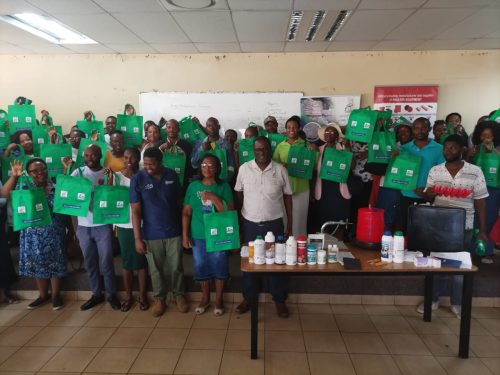
MANZINI – It was not just a training, it was a wake-up call, as farmers filled the Manzini National Library with one goal in mind, crack the code of egg production and cash in on a booming market now backed by E3 million funding opportunities.
Inside the packed venue, the mood was urgent, almost electric. Pens raced, questions fired, and ambition took centre stage as both emerging and seasoned farmers confronted a hard truth, Eswatini’s egg industry is underperforming, yet the opportunity has never been bigger.
The training, led by the Ministry of Agriculture in partnership with Crane Feeds, Farm Services, the Eswatini Agriculture Development Fund (EADF) and the Youth Enterprise Revolving Fund, positioned egg production not as a side hustle, but as a strategic economic sector capable of reshaping the country’s agricultural landscape.
FROM BACKYARD TO BUSINESS
Senior Poultry Officer Selby Nyawo told farmers that the era of informal poultry keeping must give way to precision-driven production.
He said productivity in egg farming is no accident, but the outcome of disciplined systems.
“Farmers must move from guesswork to structured production. When feeding, lighting, housing and disease control are managed properly, output increases and the business becomes sustainable,” Nyawo said.
His remarks reflect a broader structural challenge across Africa, where inefficient production systems have historically suppressed output, leaving per capita consumption at just about 36 eggs per person annually, far below the global average.
In Eswatini, this gap represents both a weakness and an opportunity.
FEEDING, SCIENCE AND THE ECONOMICS OF AN EGG
Crane Feeds expert Bheki Mhlanga cut straight to the issue, saying many farmers are unknowingly sabotaging their own businesses through poor feeding practices.
“Egg production starts with nutrition. If your feed is not balanced, your birds cannot perform. And when birds don’t perform, your profits disappear,” Mhlanga said.
He emphasised that feed quality, water management and environmental control are not technical luxuries, but economic necessities. In high temperatures, common in Eswatini, feed intake drops, forcing farmers to adjust feed composition to maintain production levels.
Globally, egg production is increasingly driven by science, with producers leveraging improved nutrition, genetics and housing systems to maximise output. The world now produces over 84 million metric tons of eggs annually, with demand continuing to rise steadily.
This surge is underpinned by a simple reality, eggs remain one of the cheapest and most accessible sources of high-quality protein.

E3 MILLION FUNDING IGNITES AMBITION
Yet knowledge alone is not enough. Capital remains the decisive factor.
EADF representative Fanele Dlamini introduced funding options ranging up to E3 million, immediately drawing intense interest from farmers eager to scale their operations.
“Access to finance is what separates small-scale activity from commercial success. We are here to support farmers who are ready to grow and operate at scale,” Dlamini said.
Farmers crowded around the funding presentation, seeking clarity on application requirements, from business plans to technical compliance, a clear indication that the sector is shifting towards structured agribusiness.
The logic is compelling. With access to finance, farmers can invest in modern housing systems, automated feeding equipment and improved flock management, all of which directly translate into higher output and better-quality eggs.
MARKET FORCES AND MISSED OPPORTUNITIES
A Farm Services representative noted that demand for eggs is no longer the problem, supply is.
“There is a ready market for eggs, but production is inconsistent. If farmers can produce reliably and at scale, they can dominate the local market and even export,” the representative said.
Across Africa, egg consumption continues to rise, reaching nearly four million tonnes, driven by urbanisation and the search for affordable protein.
Globally, average consumption now stands at around 161 eggs per person per year, highlighting just how far Eswatini and the region still have to go.
This disparity underscores the economic potential, closing the production gap could reduce imports, stabilise prices and retain millions within the domestic economy.
FARMERS FIND THEIR VOICE AND VISION
For farmers, the training was more than theory, it was transformation.
Sibusiso Mamba from Maliyaduma did not hide his frustration with past failures.
“I have been farming for years, but I was not getting results. My chickens were not producing enough eggs, and I did not understand why. Now I see it was poor feeding and management. This training has completely changed my approach,” he said.
From Ngwenya, Thandeka Dlamini spoke with measured optimism.
“We have been given practical knowledge that we can apply immediately. If we implement what we learned, production will increase, and that means profit. This is a real business opportunity,” she said.
Meanwhile, Mandla Nxumalo from Ngculwini is already thinking bigger.
“I came here with interest, but I am leaving with a business plan. With the knowledge and the EADF funding, I am ready to expand and produce at a commercial level,” he said.
A SECTOR ON THE BRINK OF TRANSFORMATION
The implications extend far beyond individual farmers.
As egg production scales up, it is expected to stimulate demand across the agricultural value chain, from feed manufacturers and veterinary services to transport and retail.
At the same time, global trends are opening new frontiers. Consumers are increasingly demanding higher-quality eggs, including enriched and welfare-friendly products, which can command premium prices and unlock export markets.
In countries that have embraced structured poultry systems, production has surged, with some farms producing up to 500 eggs per hen over extended cycles, significantly improving profitability and sustainability.
For Eswatini, the path forward is clear but demanding.
It requires disciplined farmers, accessible financing and a shift towards science-based production.
What was evident in Manzini is that the appetite is there.
And if the momentum holds, the country may soon discover that its next agricultural breakthrough is not in vast fields, but in the quiet, consistent productivity of a laying hen.