


The Minister of Agriculture, Mandla Tshawuka, addressing farmers during the National Maize Variety Field Day.
BY SIBUSISIWE NDZIMANDZE | JOURNALIST
MAHLANYA– Eswatini is intensifying efforts to secure its maize supply as the government moves to tackle low productivity, rising climate pressures and the country’s long-standing dependence on imports.
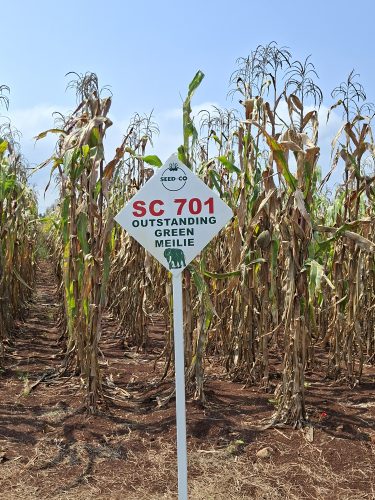
That message came through strongly at the 2026 National Maize Seed Variety Field Day, where farmers, seed companies and agricultural officials gathered at Mahlanya to assess how different maize varieties perform under local conditions and to explore practical solutions for improving national output.
Beyond the seed demonstrations, the event underscored a much bigger national concern: Eswatini still does not produce enough maize to feed itself.
The country requires about 140,000 metric tonnes of maize each year to meet national demand, yet current production stands at roughly 75,000 metric tonnes, leaving a deficit of around 65,000 metric tonnes that continues to be covered through imports, mainly from South Africa. Despite maize being planted on about 75,000 hectares, yields remain low, averaging about 1.2 tonnes per hectare.
For government, the solution lies not simply in planting more land, but in producing more maize from the right land.
According to Christopher Mtsetfwa, Senior Agricultural Officer in Technical Services, Eswatini is now encouraging a shift towards concentrating maize production on about 40,000 hectares of suitable land where higher yields can be achieved. If farmers are able to produce an average of four tonnes per hectare, the country could harvest as much as 160,000 metric tonnes enough to meet domestic demand and create a surplus.
“Our focus now is on productivity rather than expanding hectares. If farmers can produce more on the right land, we can meet national demand and even move towards surplus production,” said Mtsetfwa.
The approach signals a shift towards a more focused and productivity-driven maize strategy, with greater emphasis on improved seed selection, timely access to inputs, irrigation development and climate-smart farming practices.
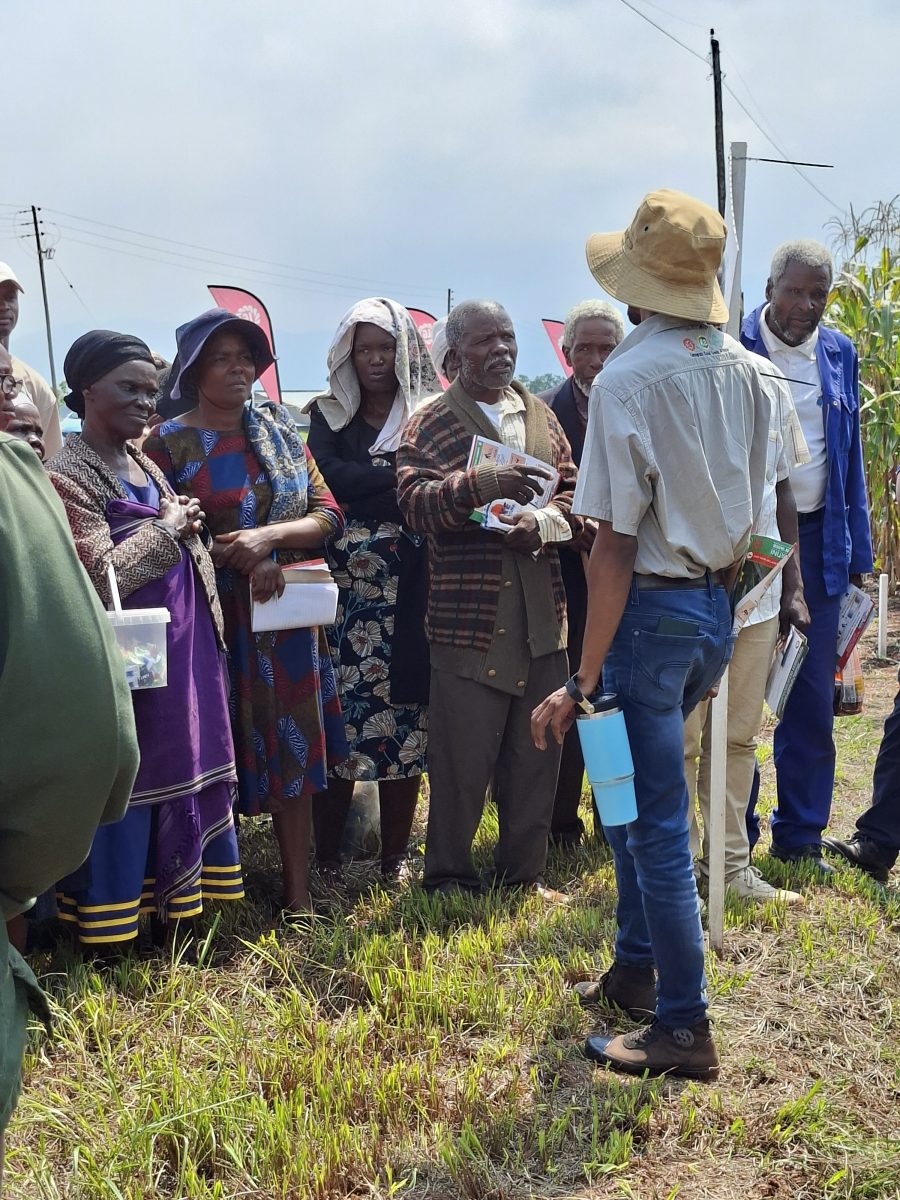
Samson Shongwe from LimaGrain-Seed Co engaging farmers on the ground, sharing insights on the maize varieties they offer.
At the field day, seed companies engaged directly with farmers, sharing information on the performance of different maize varieties under varying conditions. The demonstrations gave farmers an opportunity to compare options and better understand which seed varieties are best suited to their local environments.
Samson Shongwe of LimaGrain-Seed Co. said their participation was aimed at helping farmers make informed choices that can improve yields and strengthen resilience.
“Our role is to help farmers understand the different maize varieties available and how they perform, so they can select the right seed that will give them better yields even under changing conditions,” said Shongwe.
For farmers such as Zanele Dlamini of Lobamba Lomdzala, that information is essential. She said she attended the field day to observe the performance of different maize varieties so that she can make better seed choices for the next planting season.
“Seeing the varieties here helps me understand which seed performs better, so next season I can choose the right one and improve my production,” she said.
The event also highlighted the growing impact of climate change on crop production.
Minister of Agriculture Mandla Tshawuka acknowledged the difficult conditions farmers have faced this season, marked by erratic rainfall and extreme heat. He noted that in some cases, nearly 80 percent of the country’s annual rainfall fell within a single week, only to be followed by intense heatwaves that left many fields with little hope of a good harvest.
“We have seen a very difficult season, where most of the rainfall came within a short period and was followed by intense heat, which has negatively affected crop performance,” said Tshawuka.
He expressed sympathy for affected farmers and urged them not to lose hope, encouraging those who still have an opportunity to plant beans to do so while some rainfall remains.
“We encourage farmers not to lose hope. Those who can still plant, especially beans, should take advantage of the remaining rainfall,” he said.
His remarks reinforced an important reality: improving seed choices alone will not be enough if Eswatini is to achieve food security in an era of climate uncertainty.
The Ministry says farmers also need timely access to essential inputs such as tractors, manure, seed and fertiliser, alongside stronger support systems that allow them to plant on time and manage crops effectively.

Manzini Regional Administrator (RA), Prince Chief Gija Dlamini, visiting one of the stalls at the National Maize Variety Field Day in Mahlanya.
Water management remains another major challenge. Although the country received substantial rainfall this season, much of that water was lost because of limited harvesting and irrigation infrastructure. This is why government is working closely with the Eswatini Water and Agricultural Development Enterprise (EWADE) to strengthen irrigation systems and support more reliable production.
The broader significance of the field day, therefore, extended far beyond showcasing seed varieties. It pointed to the urgent need for a coordinated national effort to close the maize deficit through better productivity, stronger infrastructure, targeted support and more resilient farming systems.
As Eswatini continues to grapple with the cost and vulnerability of import dependence, the message from Mahlanya was clear: the future of food security will depend not only on how much maize is planted, but on how efficiently, sustainably and strategically it is produced.