


BY: SIBUSISIWE NDZIMANDZE | JOURNALIST
SIPHOCOSINI — On the outskirts of Mbabane, where many young people wake up each day caught between rural hardship and the pull of the city, a new farming programme is beginning to stir hope.
Siphocosini is among 40 chiefdoms across Eswatini selected to benefit from the E851 million Smallholder Agricultural Productivity Enhancement and Marketing Project (SAPEMP), a major national intervention expected to support about 3 000 farmers directly, touch more than 117 000 people indirectly and create around 7 500 jobs along the agricultural value chain.
For Siphocosini, local leaders say the significance goes far beyond farming. They see the programme as a chance to unlock work for young people, strengthen household incomes and turn a community on Mbabane’s doorstep into a productive agricultural hub.
For years, many families in the area have depended on rain-fed farming, with production often limited by unreliable water and weak access to markets. Young people, in particular, have had few local opportunities and have often looked toward town for survival. Now, with irrigation support in sight, leaders believe agriculture could become a real source of jobs and dignity much closer to home.
Siphocosini Indvuna yeNkhundla Wilton Jazi Mamba said the area had long believed agriculture could do more than feed households. He said it could also create work and drive local economic activity.
“Early in 2025 we wrote to the Ministry of Agriculture requesting support for irrigation agriculture infrastructure in our area. At the time we highlighted that we already had strong performing maize and vegetable farmers who were ready to expand production if irrigation support was introduced,” said Mamba.
He said when the SAPEMP opportunity emerged, Siphocosini was ready because local leadership had already been pushing for a farming future built on irrigation and commercial production.
“Of course we went through the same pre-qualification process as other areas, but I believe our competitive edge was that we had already demonstrated our commitment to developing commercial agriculture and showed that we were ready,” he said.
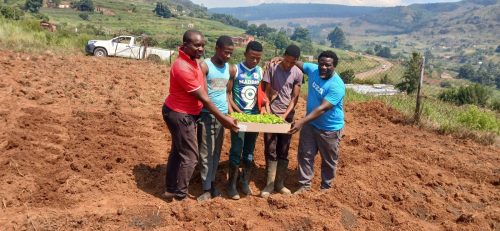
That readiness, he said, included mobilising more than 120 farmers around the Masaphasapha Dam area, not only with food production in mind, but with the hope of creating employment for local people.
In Siphocosini, the promise of SAPEMP is not just about fields and yields. It is about what happens around the fields too. It is about young men and women finding work on farms, in transport, in input supply, in packaging, in food vending and in the many small businesses that spring up when an area starts producing more.
“With access to at least one hectare and year-round production, each farmer can potentially create four to five direct jobs on the farm, with even more opportunities during peak seasons. On the indirect side we see additional employment through input supply, transport and marketing. In total we estimate the project could generate between 600 and 1 200 jobs,” said Mamba.
For a community so close to the capital but still carrying many rural limitations, that prospect is powerful.
Mamba said Siphocosini’s location could become one of its greatest advantages. Sitting near Mbabane and linked to growing road infrastructure, the area is well placed to supply produce to urban markets while also benefiting from nearby economic activity.
He pointed to the surrounding Montigny timber operations, which employ more than 10 000 people directly and indirectly, as an example of the ready demand already present in the area.
“That creates immediate demand for food products. The influx of workers and job seekers also creates additional opportunities for food vendors, caterers, transport services and accommodation providers,” he said.
In that sense, SAPEMP could do more than improve agriculture. It could trigger a wider local economy, where farming supports other livelihoods and gives young people reasons to stay, work and build in their own community.
Mamba said improved roads would further strengthen that possibility by making it easier for farmers to move produce to markets, including regional markets.
The improved infrastructure, he said, could also attract agro-processing businesses, strengthen farm input supply chains and open up entirely new enterprises around agriculture.
“There are already opportunities in the supply of farm inputs including fertilizer blending and packaging. Our farmers currently buy about two metric tonnes of NVB fertilizer per cropping season from Farm Chemicals at E320 per bag as part of a poverty-alleviation initiative,” he said.
He added that farmers in the area accessed more than E1 million worth of agricultural inputs through the government subsidy programme in 2025 alone, showing both need and readiness in the community.
For local farmer Sipho Dlamini, the real meaning of the programme is simple: a chance for farming families to breathe again.
“For many of us farming is our main source of livelihood, but we face challenges such as water shortages and limited markets. If this programme improves irrigation and connects farmers to buyers it will change the lives of many farming families,” he said.
That hope is shared across the area, where leaders say improved irrigation could move farmers beyond survival and into stable, year-round production. With stronger water access, farmers would be able to raise yields, diversify into crops such as vegetables, maize and fruits, improve quality and reduce the uncertainty that comes with relying on rainfall alone.
SAPEMP is designed to address deeper structural problems facing smallholder farmers, including low productivity, climate shocks, environmental degradation, post-harvest losses and poor market access. Its interventions are centred on production and climate resilience, market access and finance, and stronger institutional support.
But in Siphocosini, its impact may be felt most clearly in everyday life: in a young person hired to work a hectare of vegetables, in a household earning more from produce sold consistently, in a driver transporting inputs and harvests, or in a small trader feeding workers near the fields.
For a community on the edge of the capital, SAPEMP is beginning to look like more than a farming project. It is emerging as a possible bridge between rural potential and urban opportunity — and for many young people in Siphocosini, perhaps the start of a different future.