


BY PHESHEYA KUNENE
MANZINI — The Eswatini Water and Agricultural Development Enterprise (EWADE) says smallholder farmers will benefit from stronger climate resilience support, improved natural resource management and wider access to community-based green financing following the handover of the Hhukwini “Planting Trees for the Future” project and the launch of the 2025/26 call for proposals.
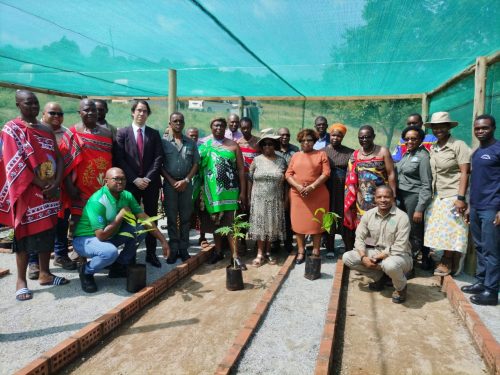
Speaking during the handover event at Hhukwini on 5 March, SAPEMP representative Nokulinda Mazibuko-Motsamai said the project was not merely symbolic, but a practical investment in sustainability, community empowerment and long-term environmental stewardship.
She said the initiative was laying a foundation for healthier ecosystems, stronger livelihoods and a more resilient future for rural communities.
Her remarks come at a time when agriculture remains vital to Eswatini’s economy and to household survival in the countryside, despite the sector’s structural pressures. Government’s Programme of Action says agriculture’s share of GDP stood at 8.1 percent in 2023, while a World Bank-backed 2025 document noted that the sector accounted for 12.4 percent of employment. IFAD, meanwhile, says around 75 percent of Eswatini’s people live in rural areas and more than 70 percent depend on small-scale agriculture for income and subsistence.
That reality gives weight to EWADE’s message. Mazibuko-Motsamai said the Hhukwini handover reflected a growing partnership between EWADE and the Eswatini Environment Fund under the Smallholder Agricultural Productivity Enhancement and Marketing Project, widely known as SAPEMP.
Through that arrangement, the Eswatini Environment Fund has been identified as manager of the SAPEMP Green Challenge Fund, a financing mechanism intended to support community-driven environmental restoration and climate resilience initiatives.
She said the Green Challenge Fund was designed to encourage innovative green enterprises and solutions among women, youth and resource-poor beneficiaries in SAPEMP project areas. Through a competitive grant system, she said, the fund would support investments that are not only environmentally sound, but also economically viable and capable of scaling up to benefit more smallholder farmers.
In a country where farming livelihoods are repeatedly hit by drought, erratic rainfall and land degradation, that support could prove decisive. FAO reported in August 2025 that the 2024–2025 El Niño episode, one of the strongest in decades, reduced annual rainfall in Eswatini from 850mm to 650mm and increased hailstorm incidents by 300 percent. FAO has also warned that the sharp climate shocks underline the urgency of building more resilient farming systems and reducing dependence on unreliable rainfall.
Mazibuko-Motsamai said projects such as Hhukwini’s tree-planting initiative must be viewed in that broader context. Tree planting, she said, is not only about restoring degraded land, but about protecting water sources, improving soil health, supporting food security and safeguarding rural livelihoods in the face of climate change.
That matters directly to farmers. Better vegetation cover helps conserve water catchments that feed irrigation systems. Improved soil health can raise crop performance. Restored landscapes can reduce erosion, protect grazing areas and improve the long-term productivity of communal land. In rural Eswatini, where one poor season can push vulnerable households deeper into hardship, environmental restoration is increasingly becoming an economic necessity rather than a side issue.
EWADE’s own mandate places irrigation-led agricultural development at the centre of that transformation. On its official platform, the agency says it exists to promote the participation of smallholder farmer organisations in irrigated commercial agriculture as part of a poverty-eradication drive for rural areas. It also says it is focused on enhancing private-sector development through the involvement of small and medium enterprises in agricultural development.
That irrigation focus is critical. FAO said in 2023 that agriculture and forestry accounted for 7.05 percent of Eswatini’s GDP and noted that the sector’s vulnerability was exposed sharply in 2016, when severe drought triggered a contraction of 11.2 percent. The agency argued that stronger irrigation systems are essential if Eswatini is to reduce its dependence on rainfall and stabilise production.
Mazibuko-Motsamai said EWADE, through SAPEMP, is working with communities across the country to promote integrated natural resource management, climate-resilient agriculture and sustainable landscape restoration. She said the partnership with the Eswatini Environment Fund was important because it linked those technical interventions to accessible financing mechanisms for locally led environmental solutions.
That combination of infrastructure, finance and community participation is where the real story lies. Rural producers often have land and labour, but remain constrained by weak water systems, limited capital, climate risk and poor market access. The Green Challenge Fund is being positioned as one tool to help close that gap, especially for smaller and poorer producers who are often locked out of formal agricultural finance.
There is also a strong development angle behind the initiative. IFAD says Eswatini continues to face high rural poverty and unemployment, particularly among young people, making agricultural commercialisation and resilience-building central to inclusive growth. For women and youth, support for green enterprises could create opportunities that go beyond subsistence farming and into income generation, local enterprise development and stronger participation in agricultural markets.
Mazibuko-Motsamai urged communities, civil society organisations and innovators to respond actively to the 2025/26 call for proposals by putting forward projects that restore ecosystems, strengthen climate resilience and create sustainable livelihoods. Her message was clear: local solutions will matter most in the next phase of Eswatini’s rural development drive.
For farmers, the significance of Hhukwini is not just in the trees planted or the speeches delivered. It is in what the project signals about the future direction of agricultural development in Eswatini. If climate finance, irrigation expansion and community-based restoration are aligned properly, they could help move more smallholders from vulnerability to productivity, and from survival farming to stronger market participation.
In that sense, the handover at Hhukwini was more than a local event. It was a marker of where Eswatini’s farming future is heading — towards a model in which water security, climate-smart agriculture and rural enterprise are no longer treated separately, but as part of one urgent national mission. With climate pressure rising and rural livelihoods under strain, the success of that mission may well determine whether the country’s farmers merely endure the next decade, or truly grow through it.