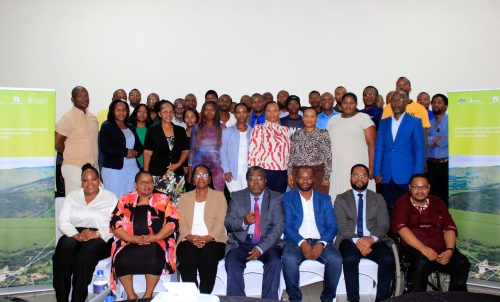
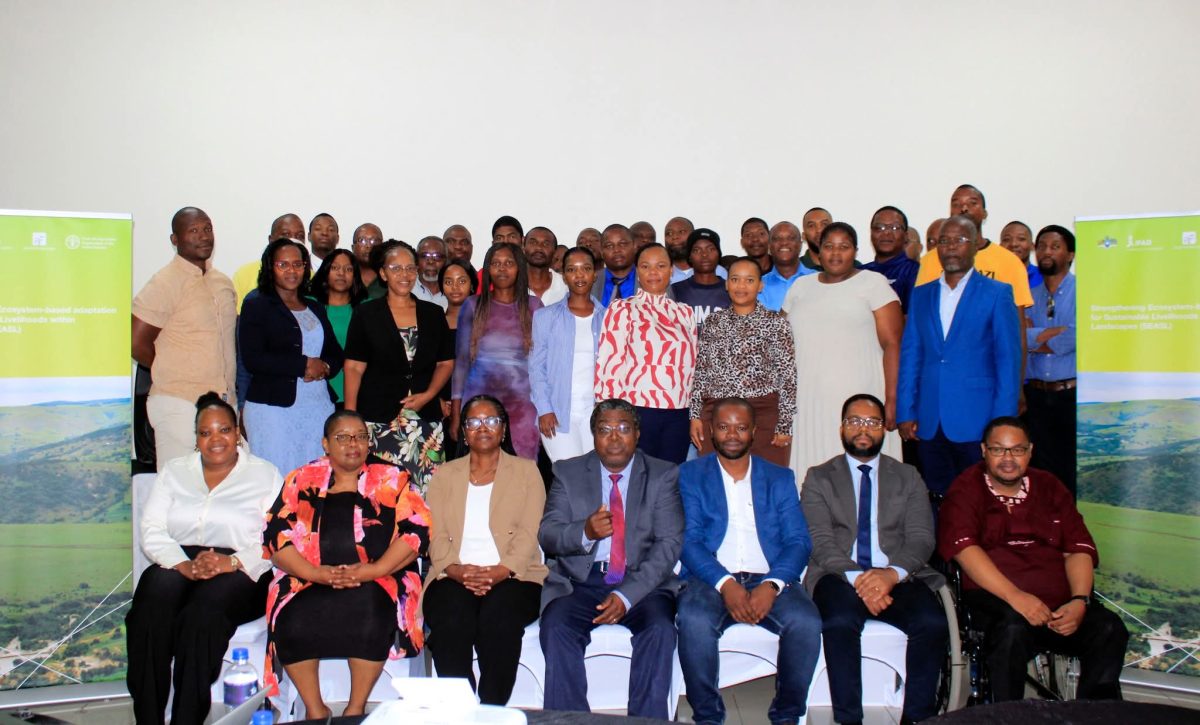
Stakeholders pose for a group photo during the national consultation on the Strengthening Ecosystem-based Adaptation for Sustainable Livelihoods within Landscapes (SEASL) project.
BY SIBUSISIWE NDZIMANDZE | JOURNALIST
MANZINI – As drought cycles tighten and weather patterns grow increasingly unpredictable, Eswatini’s smallholder farmers are being placed at the centre of a new national effort to strengthen resilience and protect rural livelihoods.
The Food and Agriculture Organization of the United Nations (FAO), working in collaboration with the Government of the Kingdom of Eswatini through the Ministry of Agriculture, the Ministry of Tourism and Environmental Affairs, and the International Fund for Agricultural Development (IFAD), convened a national consultation at The George Hotel in Manzini to shape a new climate resilience initiative known as the Strengthening Ecosystem-based Adaptation for Sustainable Livelihoods within Landscapes (SEASL) project.
While policy discussions unfolded at The George Hotel, the real focus of the proposed project lies in the fields, rangelands and forests of Eswatini particularly in the Lubombo, Ngwempisi and Malolotja landscapes, where climate and human pressures continue to threaten agricultural productivity and natural resources.
From Consultation Rooms to Farmers’ Fields
The SEASL project is designed to reduce climate- and human-induced vulnerability in agro-ecosystems while strengthening rural livelihoods. At its core, the initiative promotes ecosystem-based adaptation a practical approach that uses nature itself as a buffer against climate shocks.
For farmers, this could translate into improved soil management, restoration of degraded grazing lands, water harvesting systems, agroforestry integration and diversified income opportunities that reduce dependence on a single crop or unreliable rainfall patterns. Building on community consultations conducted in affected areas in recent weeks, the project seeks to strengthen the adaptive capacity of smallholder farmers, landscape-level institutions and community natural resource management structures. The emphasis is on practical, participatory solutions shaped by farmers themselves.
Why This Matters for Farmers
Across Eswatini, smallholder farmers continue to face mounting challenges. Prolonged dry spells, soil degradation, declining pasture quality, increased pest and disease pressure and reduced water availability are no longer isolated events but recurring realities. In vulnerable landscapes such as Lubombo and Ngwempisi, these pressures translate directly into reduced yields, livestock losses and unstable household incomes.
Assistant FAO Representative Howard Mbuyisa applauded the Government of Eswatini for enabling FAO to mobilise resources for climate adaptation. He noted that the project speaks directly to FAO’s comparative advantage in supporting communities faced with prolonged drought and emphasised that FAO has a responsibility to respond to emerging climate challenges.
For farmers, that response is expected to translate into technical support, capacity building and investments in climate-resilient ecosystem management practices that strengthen production systems while protecting natural resources.
Strengthening Resilience at Grassroots Level
The Principal Secretary in the Ministry of Agriculture, Sydney Simelane, emphasised that the initiative reinforces existing national development priorities.
“The partnership between the Government of Eswatini and our development partners is cemented by these initiatives. The SEASL project strengthens resilience at grassroots level, enhancing resilience and supporting our development agenda,” he said.
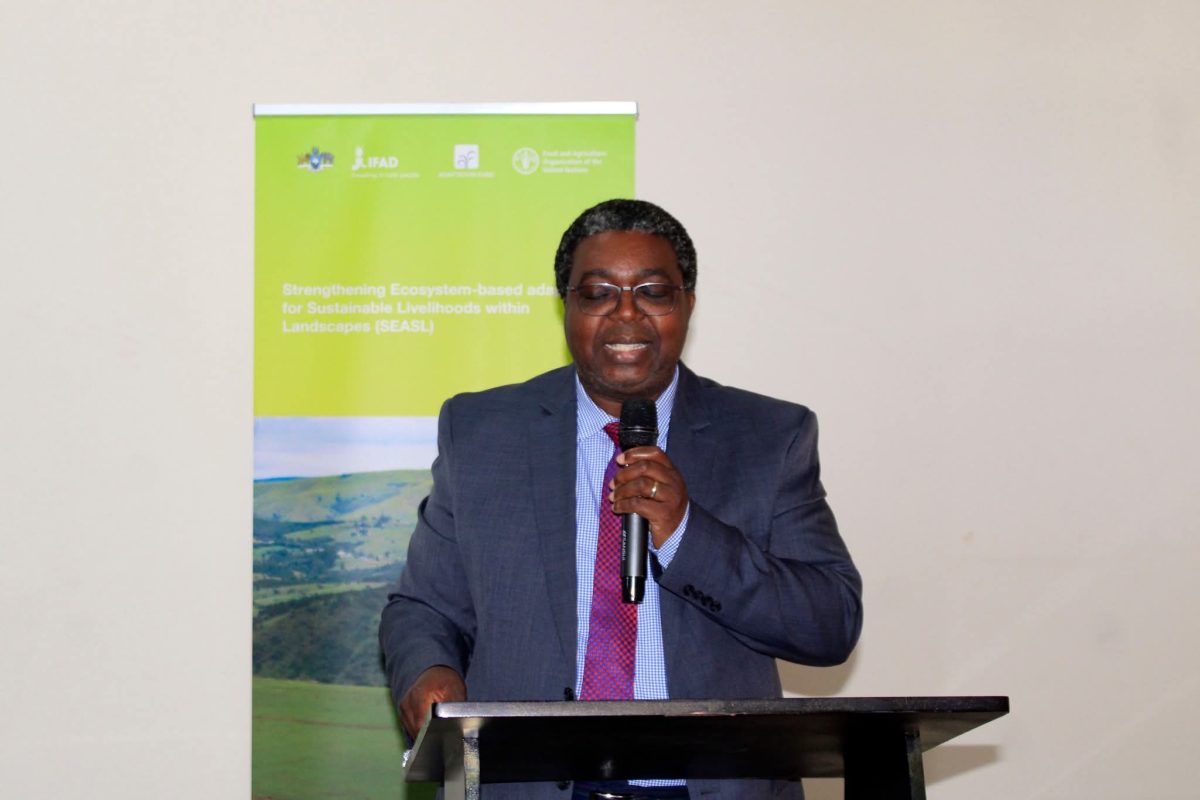
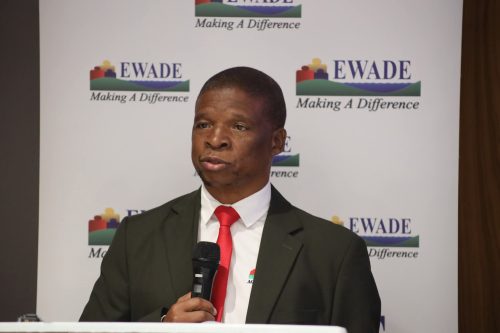
Principal Secretary in the Ministry of Agriculture, Sydney Simelane, addressing delegates at the SEASL consultation.
At grassroots level, resilience means more than surviving a drought season. It means improving soil fertility through conservation agriculture, protecting watersheds and wetlands that support irrigation, diversifying crops, integrating trees into farming systems, strengthening farmer groups and cooperatives, and improving access to markets. The project also seeks to integrate nature-based livelihood solutions, including sustainable natural resource use, value addition and climate-smart enterprises that can stabilise incomes.
Inclusion and Market Linkages
Stakeholders at the Manzini consultation stressed the importance of meaningful participation of women, youth and persons with disabilities, in line with Adaptation Fund environmental, social and gender policy requirements. Women remain central to smallholder production systems, while youth participation is essential for the long-term sustainability of the agricultural sector. Ensuring these groups benefit directly from climate adaptation investments is therefore a key component of the project’s design.
Beyond environmental protection, the SEASL concept recognises that resilience must also translate into economic opportunity. Improving market linkages, increasing household incomes, strengthening value chains and promoting sustainable agribusiness development were highlighted as critical outcomes. Resilience without profitability, stakeholders acknowledged, cannot sustain rural communities.
A Landscape-Based Future
Unlike isolated farm-level interventions, the SEASL project adopts a landscape approach, viewing forests, rivers, grazing lands and croplands as interconnected systems. Degraded forests upstream affect water supply downstream, overgrazed rangelands reduce livestock productivity, and poor land management accelerates erosion and siltation.
By restoring ecosystems while strengthening farming systems, the project aims to accelerate Eswatini’s transition toward sustainable and resilient agrifood systems.
As discussions concluded at The George Hotel in Manzini, one message stood clear: climate adaptation in Eswatini must be farmer-driven, inclusive and grounded in the realities of rural communities. If successfully implemented, the SEASL project could become a cornerstone in building a farming sector that not only survives climate shocks but adapts, innovates and thrives in the face of them.
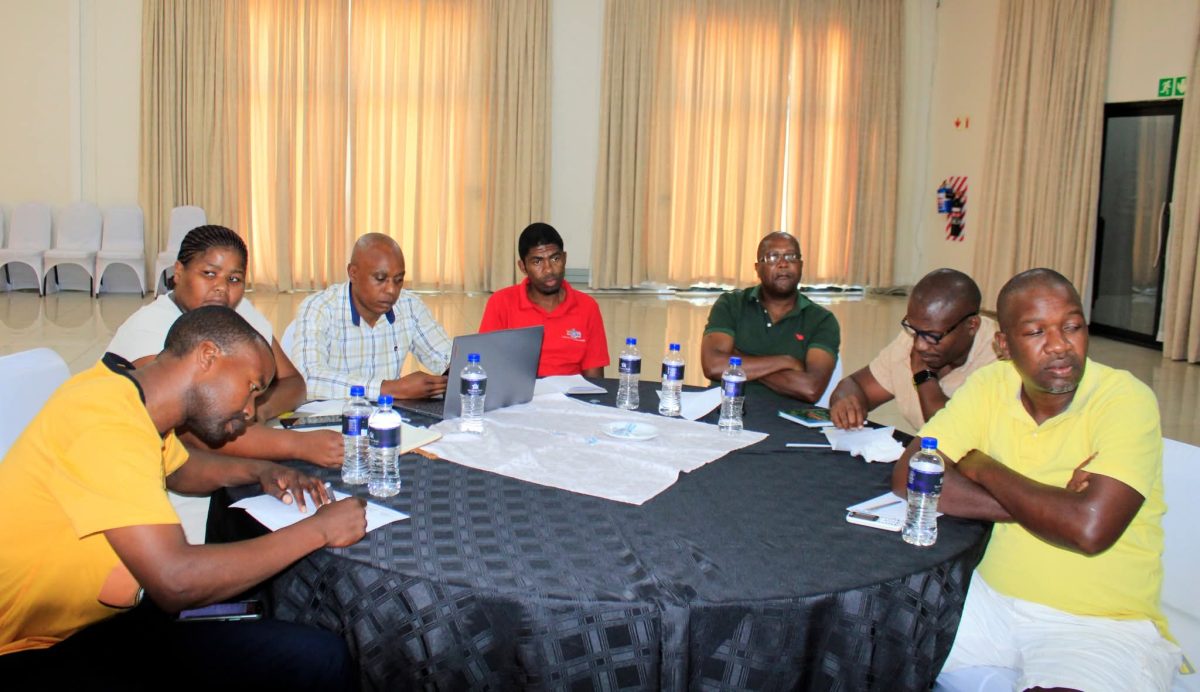
Stakeholders at the SEASL national consultation.