

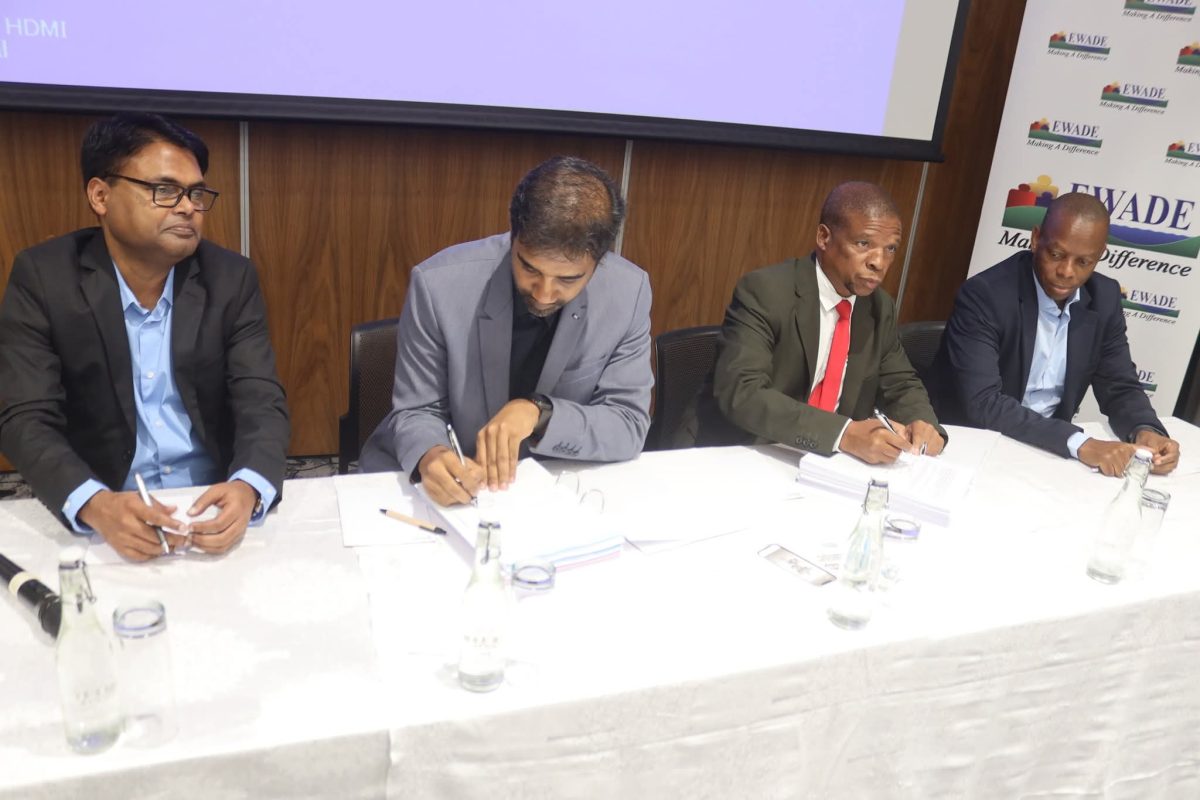
Representatives of GVPR Engineers Limited and EWADE Chief Executive Officer Dr Samson Sithole sign the E1.78 billion Main Conveyance Pipeline contract under MNWAP Phase 1B at the Hilton Garden Inn.
BY SIBUSISIWE NDZIMANDZE | JOURNALIST
MANZINI – Farmers in the Sigwe/Maloma, Mconcwane/Mcathuvane and St Philips irrigation command areas can expect progressive access to water before 2029. This follows the signing of a major infrastructure contract by the Eswatini Water and Agricultural Development Enterprise (EWADE) in partnership with GVPR Engineers Limited under the Mkhondvo–Ngwavuma Water Augmentation Programme (MNWAP).
The contract for MNWAP Phase 1B – the Main Conveyance Pipeline was signed on Monday during a ceremony held at the Hilton Garden Inn Mbabane, marking the next implementation stage of a national water investment programme valued at approximately SZL 7.5 billion.
The broader MNWAP initiative is designed to strengthen water security, provide domestic water for more than 100,000 people, and expand irrigated agriculture in the Shiselweni Region.
EWADE Chief Executive Officer Dr Samson Sithole said the signing represents a key step in translating national water infrastructure into practical agricultural gains.
From Dam Construction to Water Delivery
Phase 1B follows progress under Phase 1A, which involves construction of the Mpakeni Dam. The dam component has been estimated at between E2.6 billion and E3.5 billion, forming one of the largest water infrastructure investments in the country.
On 13 October 2025, His Majesty King Mswati III conducted a visit to the dam site and commended the milestones achieved, including job creation and community-focused implementation. At the time, the project was highlighted as central to strengthening agricultural development and water security in Shiselweni.
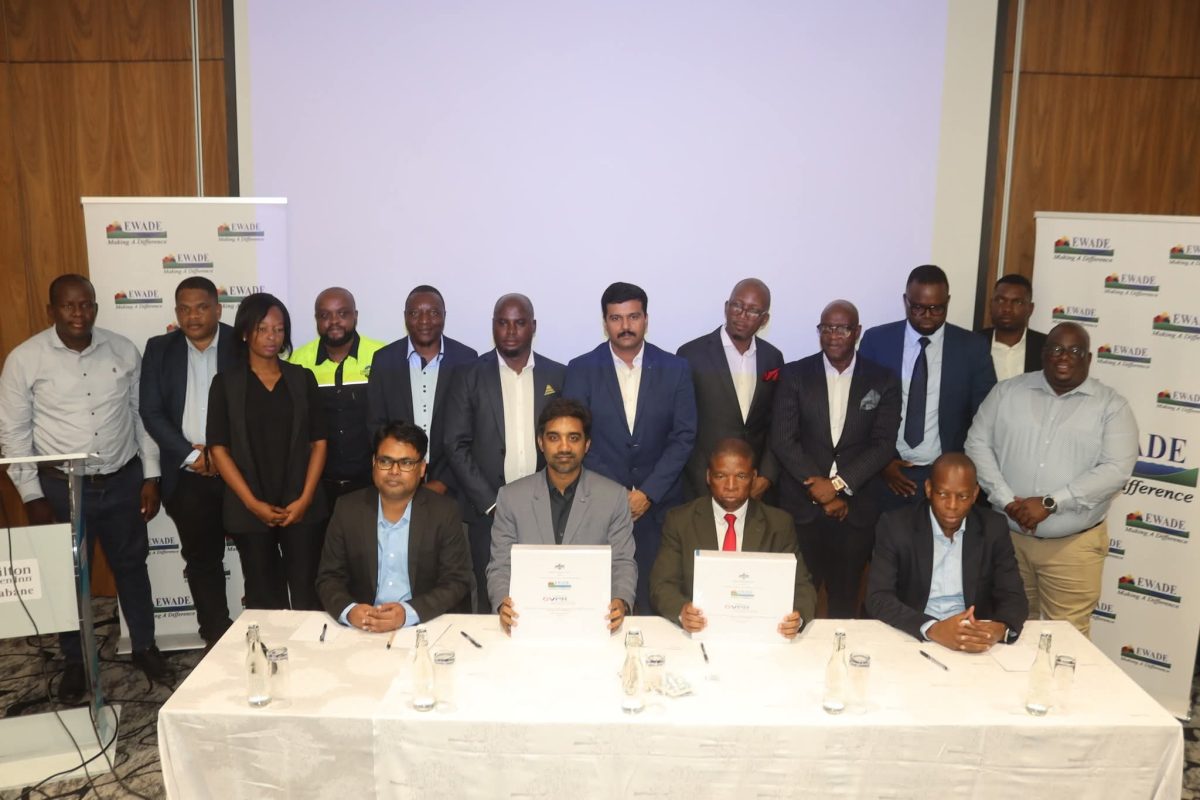
EWADE officials, GVPR Engineers representatives and project stakeholders pose for a group photo following the signing of the MNWAP Phase 1B Main Conveyance Pipeline contract.
At the Phase 1B signing ceremony, EWADE reported that construction progress at Mpakeni Dam stood at 44% as of end-January 2026, with completion targeted for April 2028.
While Phase 1A focuses on storing water, Phase 1B is designed to deliver it to farms.
A 36km Pipeline to Unlock 4,600 Hectares
Phase 1B involves construction of a 36-kilometre high-grade steel pipeline, with diameters ranging from DN2000 to DN1800, designed to convey water from Mpakeni Dam to irrigation command areas covering approximately 4,600 hectares in Sigwe/Maloma, Mconcwane/Mcathuvane and St Philips.
The Main Conveyance Pipeline contract is valued at approximately ZAR 1.78 billion and carries a 36-month construction timeline.
Following a re-tender process conducted in line with African Development Bank procurement guidelines, the contract was awarded to GVPR Engineers Limited after a three-stage evaluation process that included preliminary examination, detailed assessment and post-qualification.
EWADE said the re-tendering process resulted in a one-year delay but strengthened compliance with governance, transparency and value-for-money standards.
Water Before 2029
Although full completion of the Main Conveyance is expected in 2029, EWADE indicated that farmers will begin to experience benefits earlier.
Dr Sithole said the pipeline has been engineered for staged commissioning. As sections are completed and pressure-tested, they can become hydraulically operational, allowing water to flow into parts of the irrigation network even while downstream construction continues.
“This means people will begin to experience progressive water availability well before full project completion,” EWADE said.
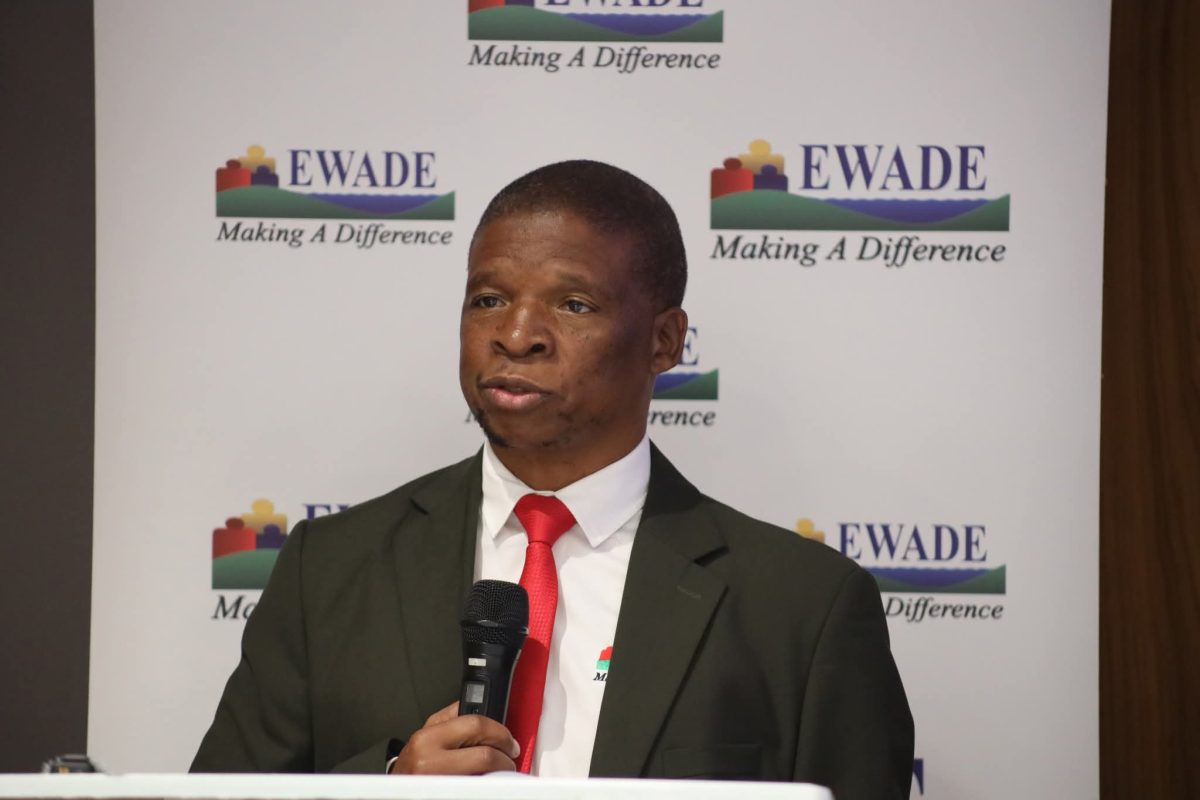
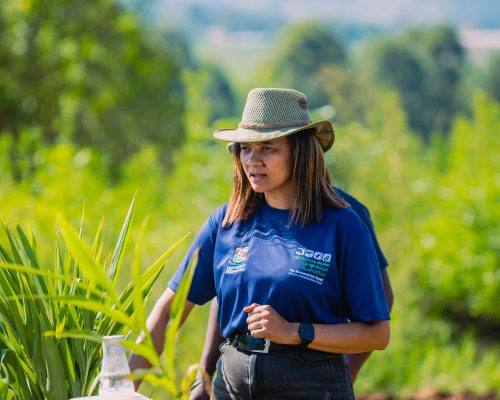
EWADE Chief Executive Officer Dr Samson Sithole addresses stakeholders during the MNWAP Phase 1B contract signing ceremony, outlining the project’s impact on irrigation expansion and water security.
For farmers, earlier access to irrigation water can improve planting decisions, stabilise yields and reduce exposure to erratic rainfall patterns and dry spells.
Local Participation and Economic Impact
EWADE emphasised strict local employment requirements and encouraged participation of local contractors during implementation.
The dam project under Phase 1A has already generated nearly 800 employment opportunities and channelled significant expenditure to local contractors, suppliers and service providers, reinforcing the programme’s broader economic footprint.
Gravity-Fed Irrigation to Reduce Costs
EWADE said MNWAP is designed to deliver irrigation water by gravity, eliminating the need for pumping. Electricity remains one of the largest cost drivers in irrigation schemes, and the gravity-fed system is expected to reduce long-term operating costs.
Lower energy dependence can improve farm profitability, particularly for water-intensive crops and high-value horticulture.
Linking Infrastructure to Agricultural Growth
EWADE described MNWAP Phase 1B as the critical link between dam storage and agricultural production.
“Today, we sign a contract. Tomorrow, we begin building a future,” Dr Sithole said.
With Phase 1A focused on water storage and Phase 1B advancing water delivery, the programme is positioned to expand irrigated agriculture across 4,600 hectares while supporting broader water security objectives in Shiselweni.