

BY PHESHEYA KUNENE – EDITOR
HLANE – The golden marula fruits are falling across the Lowveld and this year’s EMAGANU season is turning what was once a traditional harvest into a money-making machine for rural farmers and women-led cooperatives.
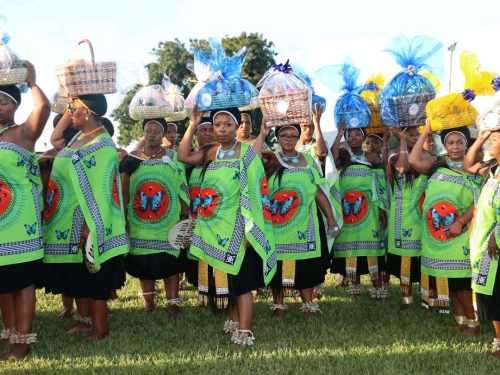
After His Majesty King Mswati III commissioned Lutsango for the Buganu Ceremony at Buhleni this weekend, the season is officially underway and so is the cash flow.
“This is our bonus season,” laughs Sipho Dlamini from Malindza, carrying a bucket filled with marula fruits.
“We are selling buganu, jam, and seeds and every sale means real money for school fees and groceries.” For many families, marula income tops E500 per season, a welcome boost in areas where cash crops are limited.
Recent estimates place the value of Eswatini’s marula industry at around E100 million annually when traditional beer production and related activities are considered. With roughly two million trees nationwide, each producing hundreds of kilos of fruit, EMAGANU injects millions of Emalangeni into local economies while maize and sugarcane are still growing.

Across Southern Africa, the marula tree, Sclerocarya birrea, thrives in frost-free woodlands and bushveld, producing yellow juicy fruits packed with vitamin C and antioxidants. The trees are mostly wild and found from Eswatini’s Lowveld to South Africa’s Bushbuckridge and northern Namibia. Harvesting usually runs from January to March. Villagers pick the fallen fruits and deliver them to processing points where pulp, pips, kernels, and seed oil are extracted for sale.
In some Southern African regions, households have harvested an average of 440 kilograms of fruit per village per season. Marula has become a major source of cash for communities, providing up to 35 percent of household income during harvest months compared to other livelihood activities.
Marula fruits are versatile. They are fermented into buganu or traditional beer, a local favourite during EMAGANU. The pulp is pressed into juice and purees for domestic use and beverage production. Some communities produce marula wine or liqueur while others turn the fruits into jams, chutneys, and preserves sold in local markets. The most profitable product is cold-pressed marula seed oil, rich in antioxidants and prized for skincare, cosmetics, and culinary uses.
In Eswatini, Swazi Secrets is turning marula kernels into export-quality oils, lotions, and body products. Women harvesters bring buckets of seeds and earn income while supporting their families. “The oil we sell goes to markets beyond our borders and that money comes back here,” says Nomcebo Hlophe, a harvester from Siteki.
The regional market is just as promising. In Namibia, more than 80 percent of marula oil output is exported to international cosmetic buyers. Women-led cooperatives collect nearly 60 percent of the raw kernels, giving them direct access to income and decision-making in the value chain.

On the broader African market, products from marula are gaining ground. Between 2009 and 2014, export volumes of marula oil climbed from roughly 3 400 kilograms to nearly 9 900 kilograms, reflecting increasing demand for natural products.
Marula harvesting also creates jobs, particularly for women and youth. Seasonal workers are employed during peak months and cooperatives offer training and market access.
Bongani Mkhabela from the Lower Lowveld says, “This work pays school fees and fills our tables. EMAGANU is now part of how we survive and thrive.”
Challenges remain. Most production still relies on wild trees, commercial orchards are rare, and processing facilities struggle to meet full seasonal demand. Environmental factors such as drought and storms can affect yields. Despite this, the economic potential of marula is undeniable.
From buganu and jams to premium oils and international exports, the humble marula fruit is proving that in Eswatini and across Southern Africa, cash really does grow on trees