BY PHESHEYA KUNENE – EDITOR
MANZINI – While policymakers debated value chains inside the American Spaces library, a different kind of strategy was unfolding at a small display table where the aroma of roasted velvet bean clearly challenged the country’s import culture.
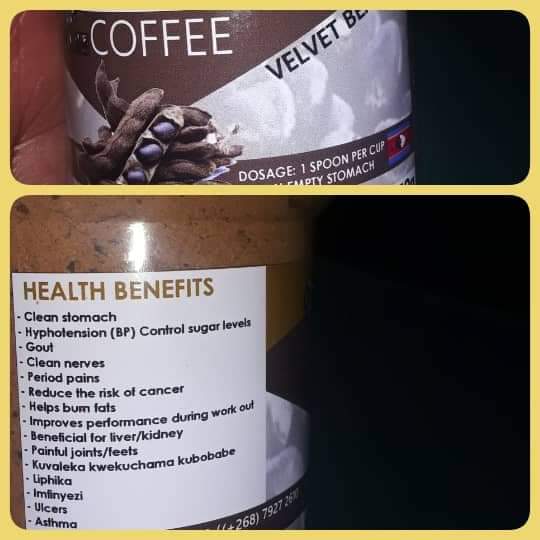
The man behind the packets did not speak in policy language. He spoke in kilograms, packaging costs and delayed payments. His product, a caffeine-free coffee substitute made from velvet bean, now reaches South Africa, Canada and Israel in shipments totalling 100kg every five months. It is not yet a commercial breakthrough, but it is a border crossing.
“I have the product and the quality meets international standards. What I need now is the market. The demand is there, but it is moving slowly,” said velvet bean coffee producer Zet Dlamini.
Eswatini imports most of its conventional coffee. That is the economic reality. Yet here stands a local processor with export paperwork in hand and stock waiting for buyers. The contrast is as sharp as it is instructive.
The enterprise began in Matsapha in 2003, long before agro-processing became fashionable. Retirement from formal employment did not end production. It relocated it to Mankayane, where land has now been secured for a dedicated processing facility. The vision is industrial. The current operation is still manual. The gap between the two is measured in markets, not motivation.
Domestic buyers exist but operate in bursts. Pharmacies and small retailers take 250g units. Bulk customers purchase in 5kg, 10kg and 25kg lots. The shelves move, then stall. Export demand is more consistent but limited by scale. The result is a warehouse that doubles as a waiting room for opportunity.
“I have a lot of coffee in stock and I am ready to supply both the local and international market. With the right support and packaging improvements, this business can grow,” Dlamini added.
Regional trade figures reveal the structural imbalance. Millions of emalangeni leave the country annually to pay for imported coffee while local substitutes struggle for shelf space.
Velvet bean, meanwhile, produces between 1.5 and 3 tonnes per hectare under good conditions, improves soil fertility and serves as livestock feed. Its agronomic value is established. Its commercial ecosystem is not.
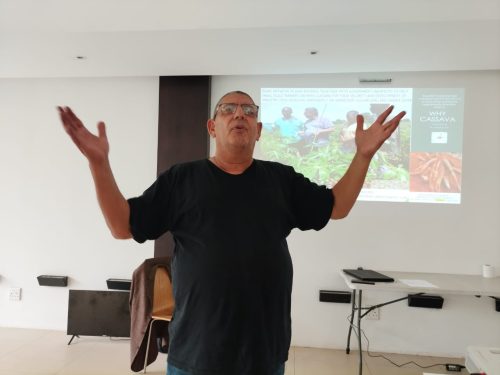
That ecosystem was the subject of a stakeholder meeting convened by the Organisation for Women in International Trade (OWIT) in partnership with Dlanimphilo Multi-Purpose Cooperative. Sixty-four participants, from ministries to micro-enterprises, gathered to design a closed value chain capable of moving velvet bean from field to factory to foreign market.
The discussions were technical, but the stakes were practical.
Researchers stressed that export credibility begins with certified seed and laboratory testing aligned to international standards. Non-compliant produce would not reach the market.
“Seed quality is not negotiable. At the research station we test according to international standards, and any produce that does not comply is disqualified,” said Malkerns Research Station Senior Extension Officer Nonhlanhla Mkhwanazi.
Financial service providers argued that digital payment systems are no longer optional for cooperatives seeking scale. Government officials outlined compliance frameworks that turn informal groups into legally recognised economic entities.
Behind the presentations sat farmers doing quiet calculations. Quality control means higher input costs. Certification means paperwork. Aggregation means shared governance. But it also means access to larger contracts and stronger negotiating power.
The cooperative model, often treated as a social structure, was reframed as an industrial tool. Individually, producers supply kilograms. Collectively, they supply tonnes. That difference determines whether a buyer responds to a phone call.
“The multi-purpose cooperative model allows producers to aggregate volumes, improve quality control and access premium markets that would be impossible individually,” said Dududzile Nhlengetfwa, President of the Organisation for Women in International Trade.
Globally, velvet bean demand is expanding in animal feed, organic inputs and nutraceutical processing. Regionally, climate-resilient crops are gaining policy support. Locally, production remains fragmented, statistics remain thin and marketing channels remain underdeveloped.
The exporting processor represents the leading edge of a sector that has not yet organised itself. His unsold inventory is not simply a business problem. It is evidence of a system still learning how to connect production to demand.
Rural industrialisation rarely arrives with spectacle. It arrives in small consignments, in upgraded packaging, in a new cooperative constitution, in a laboratory certificate attached to a bag of beans. It arrives when a farmer’s child with formal training joins the business to handle compliance and branding. It arrives when a shipment clears customs for a market that did not previously exist.
Inside the meeting, speakers described aggregation, traceability and export readiness. Outside, a farmer poured samples into paper cups and watched reactions. Some visitors nodded politely. Others asked for prices. A few discussed distribution. That is how value chains begin, not in theory but in conversation.
If the closed model succeeds, velvet bean could shift from being an underutilised legume to a structured agro-industrial input, reducing import dependence while creating rural processing jobs. If it fails, the country will continue exporting raw potential and importing finished products.
For now, the numbers are modest. One hundred kilograms. Three export destinations. A processing site under development. A cooperative electing a committee. A research officer insisting on certified seed.