



BY: SIKHONA SIBANDZE | JOURNALIST
Source: UNESWA Official Facebook Page
MANZINI – The University of Eswatini’s (UNESWA) Horticulture Department has earned regional recognition after one of its postgraduate researchers won a top award at the 2026 Combined Congress—an achievement that could also translate into practical value for growers struggling with expensive and unreliable horticulture seedlings.
Hosted by North West University in Potchefstroom, South Africa, the annual Combined Congress drew together three leading scientific bodies: the Soil Science Society of South Africa (SSSSA), the Southern African Society for Horticultural Sciences (SASHS), and the South African Society of Crop Production (SASCP). The forum is widely regarded as a key platform for researchers to present innovations with real-world relevance for the agricultural sector.
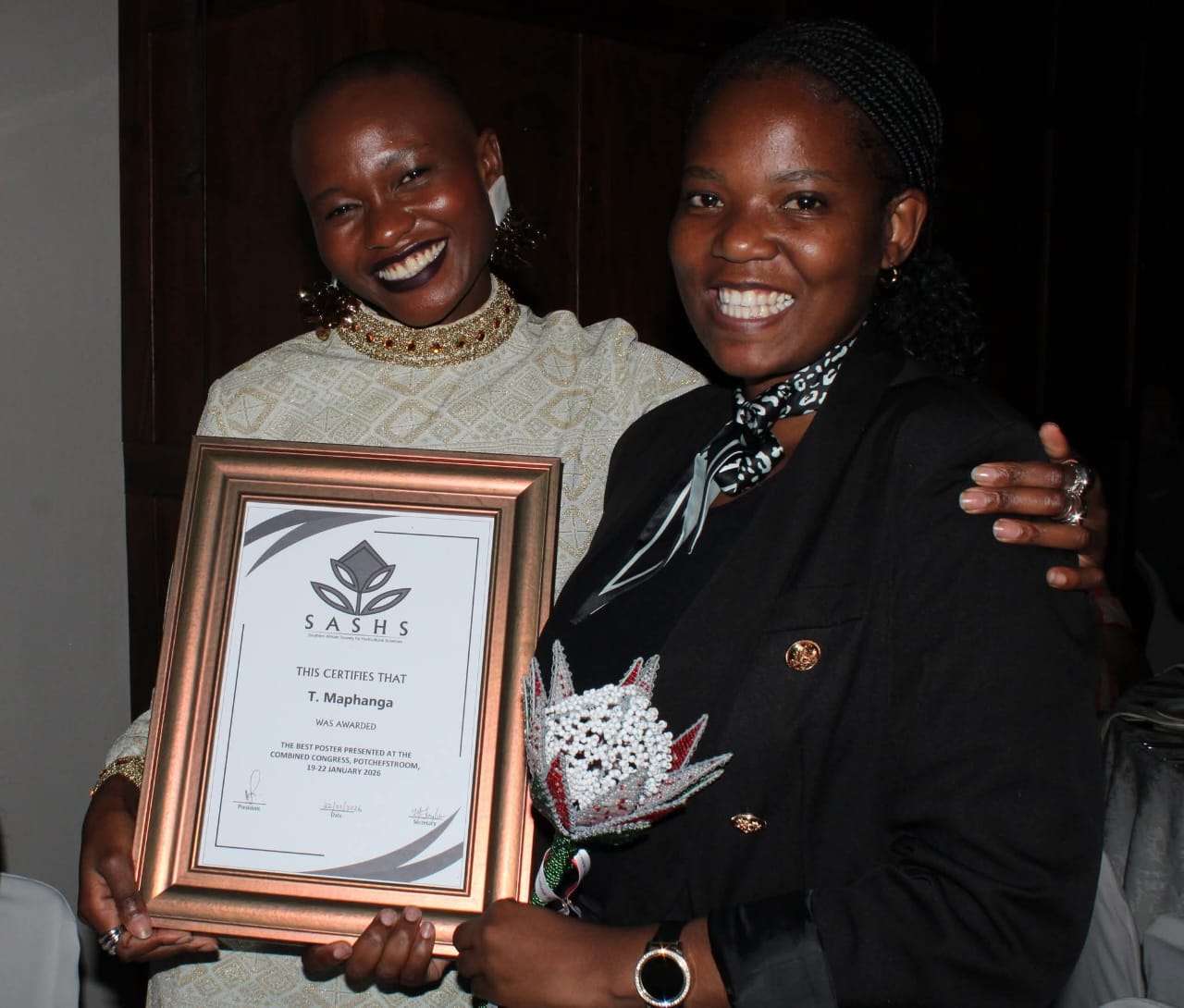
At the centre of UNESWA’s success was Thandiswa Maphanga, a Masters student in the Plant Biotechnology research group at UNESWA’s Luyengo Campus, who received the Best Poster Presentation Award for her study titled “Effects of Plant Growth Regulators on Micropropagation of Red Pepper (Capsicum annuum L.).” The recognition also underscored the work of the solution-driven research group led by Dr C.S. Mavuso, with the UNESWA delegation led by Dr P.C. Carmichael and Dr C.S. Mavuso.
UNESWA said its team delivered both oral and poster presentations, showcasing research focused on plant biotechnology and horticultural crop cultivation practices. Presenters included PhD students Nhlanhla Hlophe and Zanele Phiri, alongside Masters students Thandiswa Maphanga, Temahlubi Dlamini, Mbali Dlamini, and Mfihlakalo Zikalala.
Why this matters for growers
Beyond academic recognition, Maphanga’s red pepper research speaks directly to a pain point many horticulture farmers know too well: the cost and quality of planting material.
For growers, red pepper remains a high-value crop—but productivity often depends on one make-or-break factor at the very start: seedling quality. When seedlings are weak, uneven, or infected, farmers pay twice—first at the nursery, and again through poor crop establishment, uneven plant stands, delayed harvesting, lower yields, and increased pest and disease pressure.
The award-winning study explored how different plant growth regulators affect multiplication during micropropagation, a tissue-culture method used to produce large numbers of uniform plants from small tissue samples under controlled conditions.
For the horticulture industry, the significance is that micropropagation research can help lay the groundwork for more dependable seedling systems by:
- Multiplying preferred varieties faster, especially where demand outstrips supply
- Producing uniform seedlings for consistent plant stands and predictable production
- Reducing losses linked to poor germination and uneven growth seen in some seed batches
- Strengthening local nursery systems by developing standardised propagation protocols
While micropropagation is not a quick fix for every farmer—because it requires specialised laboratory capacity—its value becomes clearer where the market needs high volumes of consistent planting material, particularly for commercial horticulture and nursery operators supplying multiple growers.
From conference recognition to farm-level impact
The next step, agribusiness stakeholders say, is ensuring such innovations do not end at poster boards and conference halls. Turning micropropagation protocols into farm-level benefits will likely require:
- Partnerships between researchers and local nurseries
- On-farm trials to validate performance of tissue-culture-derived seedlings under local conditions
- Business models that make high-quality planting material accessible and affordable for growers
If adopted at scale, micropropagation protocols for red pepper could help stabilise seedling supply, improve crop uniformity, and support higher-value horticulture production—precisely the kind of innovation farmers need as margins tighten and markets demand consistent quality.
Funding support
UNESWA said participation and research dissemination were supported through the African Research Initiative for Scientific Excellence (ARISE). The research work was financially supported by the European Union through the ARISE pilot programme (Grant no. DCI-PANAF/2020/420-028), implemented by the African Academy of Sciences with support from the European Commission and the African Union.